
A Sunday Afternoon on the Island of La Grand Jatte
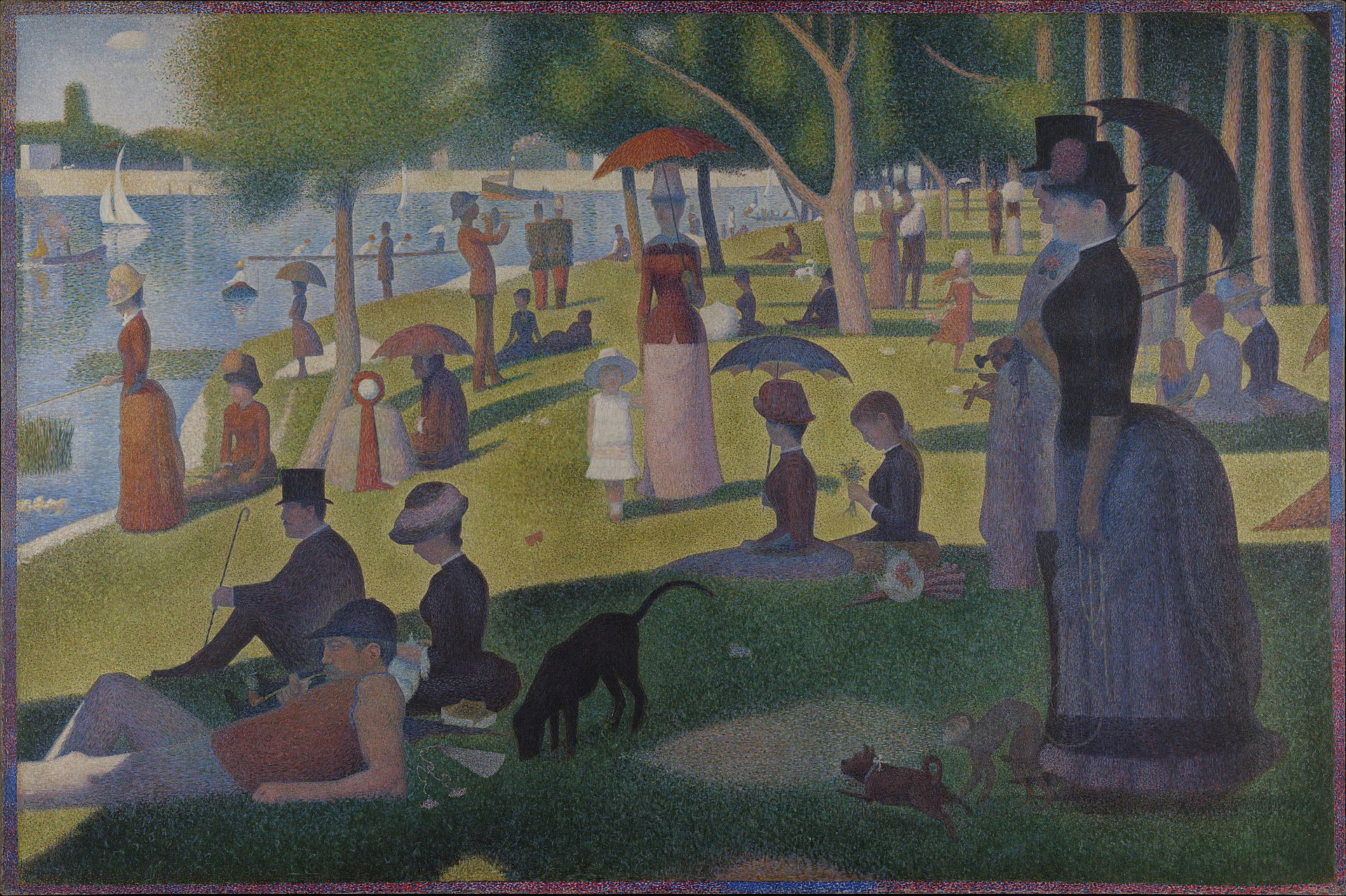
Sunday in the Park with George was a Stephen Sondheim musical inspired by the iconic George Seurat painting.
The production opened on Broadway in 1984, exactly one hundred years after the artist started work on A Sunday Afternoon on the Island of La Grande Jatte; the show went on to win a Pulitzer Prize and many other notable awards.
The Seurat picture has also featured on the cover of Playboy magazine, in the film comedy Ferris Bueller’s Day Off, tv shows Modern Family, The Simpsons, and Family Guy, Looney Tunes cartoons, and has even been recreated in topiary.
When Seurat (1859-1891) began this ubiquitus work, his single ambition was that it might be accepted for exhibition at the Salon des Indépendants.
He obviously had no notion of the immense popular appeal his painting would one day achieve all around the world.
Seurat began preparations for the picture on the mile-long
La Grande Jatte island in Paris, positioned on the Seine between Neuilly and Levallois-Perret.
Located within the city’s urban centre, the island was once a rural retreat for the bourgeoisie, a bucolic area that was also renowned as a venue for prostitutes to offer their services.
Seurat spent numerous hours at the park generally observing his potential subjects, and completed many studies – thirty oil sketches, twenty-eight drawings and three large canvases.
Seurat was born into a comparatively wealthy family, and grew up in a widely creative environment that few artists are lucky enough to enjoy from an early age.
Encouraged to paint from his early teens, his formal training began at his local municipal art school, followed by studying at the esteemed École des Beaux-Arts. He spent all of his free time visiting the museums and libraries throughout Paris.
Seurat was captivated by the works of both the old masters and the inspiring artists of the preceding generations; he was eager to begin work on a painting he felt could stand alongside the greats.
His vast canvas features three dogs, eight boats, a monkey and forty-eight people gathered together on a sunny afternoon.
He wanted his figures to carry the solemnity of the sculptures of the Friars of the Parthenon – structured and formally arranged across the canvas.
Seurat was enthralled by optical illusion and perception explored by colour theorists Michel Eugene Chevreul and Ogden Rood. He aimed to incorporate a scientific process and effect within his work. Seurat explained, ‘Some say they see poetry in my paintings, I see only science.’
Seurat’s view was that if two different coloured dots overlapped, a third colour would emerge, allowing the viewer’s eyes to optically merge the pattern from a distance.
He never again felt the need to blend hues in the way artists routinely did – the benefit being that colours remained as vibrant as when they were first squeezed from the tube.
He was seeking a new language, a vision that would create a startling purity and harmony in his work, not dissimilar to classical music.
Although his technique had its detractors, who described his paintings as ‘fuzzy’, the highly regarded critic Meyer Schapiro wrote: ‘If we can isolate a single major influence on the art of the younger painters in Paris in the late 1880s, it is the work of Seurat. Van Gogh, Gauguin and Lautrec were all affected by it.’
He adapted his research, dividing colour into distinct components, seeking to create a luminous effect within the work.
Soon to be known as Pointillism, this technique consists of small distinct dots of paint applied in patterns to form an image, or to be perceived as a single hue or shade.
‘I want to make modern people, in their essential traits, move about as they do on friezes, and place them on canvases organised by harmonies of colour.’
A few of his characters are reflected unconventionally, leading art historians to be believe he portrayed them as sex workers.
Specifically, a woman on the left of the painting is seen fishing, but it is thought that it was not fish that she was hoping to hook.
The same interpretation was applied to the statuesque woman on the right with a monkey on a leash.
A Sunday Afternoon on the Island of La Grande Jatte was eventually exhibited at the eighth and final Impressionist exhibition in May 1886. Seurat was immediately recognised as the leader of a new movement – Neo-Impressionism. He was twenty-six at the time.
Not everyone concurred with Seurat’s approach, and the
German Marxist philosopher Ernest Bloch addressed the social significance of La Grande Jatte. He strongly criticised Seurat’s mechanical, almost robotic interpretation of French society, depicting Paris in such a mathematical and scientific manner.
At the age of 31 Seurat suddenly fell violently ill, and three days later died of an unknown disease, primarily related to a combination of meningitis, pneumonia and diphtheria.
La Grande Jatte went virtually unseen for thirty years following Seurat’s death. Artist and collector Frederic Clay Bartlett purchased it for $24,000 in 1924, after much urging from his wife and the curatorial staff of the Art Institute of Chicago, and presented it indefinitely to the museum.
In 1958 the painting was loaned to another venue for the first, and probably the last time.
It was borrowed by the Museum of Modern Art in New
York, where a fire occurred destroying six artworks, and injuring over thirty people
The painting was located on the floor above the fire, and was removed quickly through an emergency elevator. Although the picture was left undamaged, there have been no loans approved since.
But if you wish to share Seurat’s impression of 19th-century
Parisians enjoying their park, in one of the most admired and reproduced paintings in art history, you will find a visit to the splendid Art Institute of Chicago a memorably thrilling experience.
It is blessed with the finest examples of works by many of our greatest artists: Van Gogh’s The Bedroom, Edward
Hopper’s Nighthawks, Pablo Picasso’s Mother and Child – and an extraordinary number of other seminal works.
But George Seurat’s A Sunday Afternoon on the Island of La
Grande Jatte is to most eyes its greatest single masterpiece.