
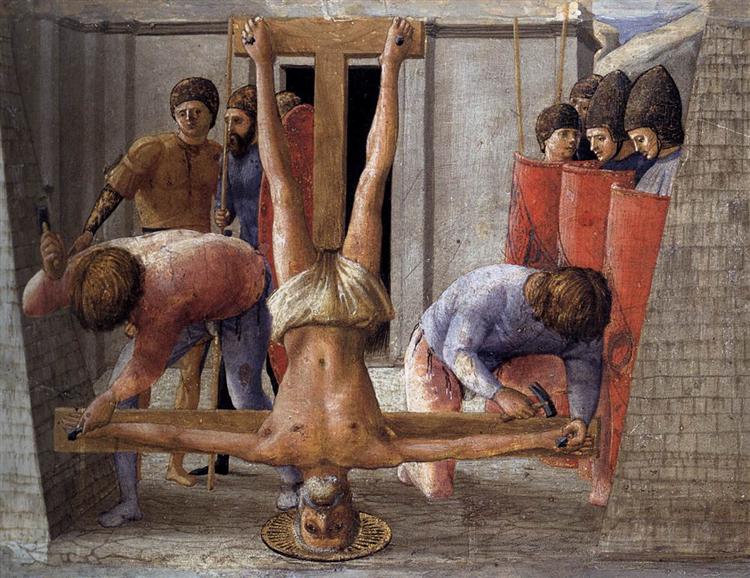
The Crucifixion of St Peter
Masaccio was born in 1401 and died in 1428 – and during six years of extraordinary inspiration, he became the single greatest influence on Italy’s Renaissance.
In fact, to many observers his radical thinking helped usher in the major foundations of all Western painting that followed.
It is difficult to comprehend that a few years in a short life would have such a bewildering impact on the history of art.
Tommaso di Simone Guidi became known by his nickname Masaccio, roughly translatable as Clumsy Tom. Supposedly this was because he was absent-minded and unconcerned about his shabby personal appearance, but was also easy going, good natured and likeable.
One of the perplexing riddles that has confounded scholars trying to dissect Masaccio’s work is fathoming exactly how he learned to paint.
There is no evidence of his serving an apprenticeship in a notable artist’s studio, in the customary way for hopeful young pupils. There is no record of his being tutored in basic skills, learning to copy the techniques of an accomplished painter.
Of course this has proved frustrating for analysts looking to unearth the answer to Masaccio’s artistic brilliance, or even identify examples of his earliest work.
It is generally accepted that at 21 he entered the Florentine Guild of Painters, though how he matriculated to secure this position remains a tantalising mystery.
His first known work was dated three months after he became a member, a small triptych painted for a church in the town of Cascia.
This little painting has been pored over by Renaissance specialists, trying to discern how this sophisticated demonstration of Masaccio’s expertise was achieved.
It did not resemble Florentine painting at all. The direct and spare portrayal of the Madonna and Child offered a clue that Masaccio had looked at Donatello’s sculptures.
Their intense realism may have sparked his interest in wanting to render the human body with heightened gestural and emotional expression.
Soon, another commission took Masaccio to Pisa, his reputation clearly spreading beyond Florence. Here he was to create an altarpiece for the Church of Santa Maria del Carmine.
Sadly, the work was to be dismantled in the 18th century and several parts were lost, but thirteen sections have been rediscovered and identified.
The most electrifying of these is a panel depicting the cross on which St Peter is being nailed, while upside down, legs spread apart.
Peter is seen quietly impassive as he undergoes this torture. Masaccio’s remarkable grasp of foreshortening and perspective is at its full power, ensuring that all is aligned to draw the viewer’s attention immediately to the central figure of Peter.
Masaccio carefully avoided showing the executioner’s faces and their human attributes, better able to isolate their callous violence.
The work was a crucial breakthrough in handling a complex composition, with all its elements arranged in an overarching unifying principle.
Precise calculation in all aspects of the picture’s construction was clearly essential for Masaccio. Further, his use of light heightened the substance of every element, from the body of the saint, to the stones of the pavement.
Masaccio’s mastery of a complicated biblical scene, The Tribute Money enhanced his position as the most scrutinised and admired painter of his era.
This painting revolutionised the way artists would progress, captivated by Masaccio’s use of scientific, linear one-point perspective.
The tax collector is demanding his payment from Christ and a large group of disciples. The head of Christ is the vanishing point of the painting, drawing eyes directly to him.
But the atmospheric aerial perspective was unique to Masaccio, creating the appearance of depth. In many ways, Masaccio was inventing 3D.
His use of light emanating from a source outside the picture casts the figures in shadow. This created the ‘chiaroscuro’ effect that da Vinci was to perfect, as he sculpted bodies with his paint strokes into three dimensional shapes.
The facial depictions in this complex group were considered particularly well drawn because of the richness and variety of their expressions.
Equally venerated was his sublime Casini Madonna, better known as The Tickling Madonna (instead of being formally titled with the name of the cardinal who commissioned it.)
The Virgin is pictured holding her child in swaddling clothes, as she both blesses and tickles him, leaving the infant giggling as he grasps her wrist.
Both their halos are rendered flatly rather than in perspective, creating the illusion that they can simply slip into one another.
Despite the traditional gold background, the Madonna and Child are seen in a surprising new way, turned three-quarters and off-centre, to suggest the idea of motion.
Her posture was considered daring and unique at the time. No previous work had ever positioned her in this way, creating a revealingly natural effect in a delightful jewel of a painting.
The outstanding Florentine painters of the mid-15th century – Filippo Lippi and Piero della Francesca – were transfixed by the rationality and pure realism of Masaccio’s art, and of course its humanity.
His greatest contribution however was made clear 75 years later, when Leonardo da Vinci, Michelangelo and Raphael, the three titans of the High Renaissance, were at the peak of their powers.
All three studied Masaccio carefully, his monumental figures and sculptural use of light were recognised as quite breathtaking; some of Michelangelo’s earliest works are studies of figures from The Tribute Money.
The majestic works of the Italian Renaissance at its zenith were firmly rooted in the paintings of Masaccio.
It is no overstatement to claim that in the passage of a few years, he altered the course of all art that was to come.