
L’absinthe
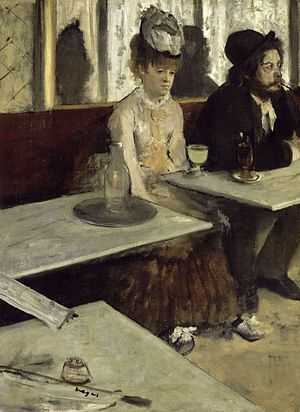
A woman slumped in her café seat, staring listlessly into space, her shoulders hunched and eyes glazed over, a glass of absinthe perched before her.
She is dressed as a prostitute; the bar probably located close to Notre Dame de Paris, generally regarded as a popular haunt for women of the night, as well as artists, poets and writers. The man accompanying her is dressed shabbily, his eyes tired and empty.
The presence of the absinthe is central – it deliberately connects the drink, which was a stalwart of bohemian life at the time, to its role in society.
The painting was entirely staged. Degas (1834-1917) produced it in his studio; the man and woman were friends of the artist. Sadly, after the painting was seen, his model Ellen Andrée was publicly perceived as a whore, his friend Desboutin as a destitute vagabond – reported by critics as a ‘man and a woman of the most degraded type.’
Degas wanted to publicly set the record straight about the painting’s subjects; Desboutin in fact led a charmed and lavish lifestyle, owning large properties in Nice, the result of his successful work as a printmaker and painter.
Ellen Andrée initially trained to become a teacher, yet abandoned this in pursuit of her passion for the theatre and modelling. She periodically posed for Renoir, and most famously for Manet in his magnificent work La Parisienne.
Degas attempted to reveal the truth about the two protagonists in his painting, when it was viewed at Christie’s auction house. But instead, the sight of the painting caused such a stir amongst an aghast audience, it had clearly offended their overall sense of decency and propriety. The picture was actually hissed out of the room, selling for a modest £180 to a helpful friend of Degas.
The presence of absinthe was alone enough to antagonise a
Victorian audience, the green spirit being held responsible for many blemishes against decency during the late 19th century.
But the radical café culture of Paris was at the time embracing audacious creativity, with absinthe acting as a gregarious social lubricant. And naturally, bohemian diehards shunned conventional notions such as marriage, monogamy, sobriety and family, which the Victorians held to so fervently.
In reality absinthe was enjoyed across all classes, to the point that its popularity became something of a crisis, swiftly infecting much of Europe.
With its very high alcohol content, and its main ingredient being greenwood leaves, it was known to render its users senseless, earning the title ‘La Fée Verte’ – The Green Fairy. Due to its psychotropic and hallucinogenic properties, it was viewed as the catalyst for the hedonistic debauchery its users were believed to indulge in.
Of course, many of the most respected and celebrated artists and writers at the time enjoyed the drink, some even citing absinthe as a source of their inspiration. Wilde, Toulouse-Lautrec, Picasso, Van Gogh, Hemingway and Baudelaire were a few of its vocal advocates.
What of Degas? An absinthe drinker himself, the painter was at the forefront of the art world, somewhat unwillingly cast as one of the leaders of the Impressionist movement.
In fact, he openly rejected the notion of himself as an Impressionist when this term was coined by the press in the 1870s; rather, he maintained his stance as a realist.
He clumsily explained that L’absinthe should not be seen as a brutal social judgement, but rather a representation of life as Degas saw it.
In general, his relationship with the Impressionists was somewhat fraught, his friendship with Manet being particularly stressful.
Although the two felt a close connection, their arguments were fervent. This was probably because the pair were able to identify each other’s weaknesses, unperceived by others. Degas mocked the Impressionist tendency to produce works in the open air, and their obsession with landscape.
Preferring to operate from his studio, Degas concentrated on human subjects, directly representing individuals as he wished them to be interpreted. The palette he used in these early years remained characteristically pale and washed-out; no hint of colour or vibrancy is presented.
Unfortunately Degas was acquiring a rather unflattering reputation for himself. Many saw him as a misogynist, and not simply as a result of his never marrying or showing any real interest in women. Almost certainly it was because of the blunt and uncompromising way in which he painted the female form, with no softening or glossing over of imperfections.
This was seen as intentionally unsympathetic, and in general his view of people was seen as rather acidic. Works such as The Rape and L’absinthe disturbed contemporaries in their bleak and remorseless portrayal of women in particular.
During his early years the artist was dependent upon money provided by his father, a prominent banker, to enable him to reject a conventional career and pursue painting. Sadly, this resulted in his been seen in artistic circles as a dilettante.
Worse, in later years Degas was also known as a staunch anti-semite. This became particularly strident during the notorious Dreyfus affair of 1894–1906. Alfred Dreyfus, a Jew, was accused of selling military secrets to Germany in an act of blatant treason.
Degas energetically supported the vilification of Dreyfus, as the trial transfixed France. Finally, Dreyfus was proven to be utterly innocent, the false evidence placed against him due to the widespread anti- semitism holding sway over much of the population.
When the truth finally emerged, a shadow was cast over Degas’ reputation as a thoughtful intellectual.
Indeed, towards the culmination of his life, Degas appeared to live a bitter lonely existence, hardly leaving the confines of his studio.
He had outlived most of his contemporaries, isolating himself with only a housekeeper for company, his eyesight now dwindling.
It was a tragic end for one of most gifted of all artists. Many of his works were majestically radiant, with an impeccable touch for pictorial structure. The use of pastel, as seen in Degas’ ballerina studies has never been equalled.
At his best, he succeeded in creating paintings that were both bewitching and thought-provoking – an immeasurable legacy of sublime art, despite Degas’ uneasy life.