
Judith with the Head of Holfernes
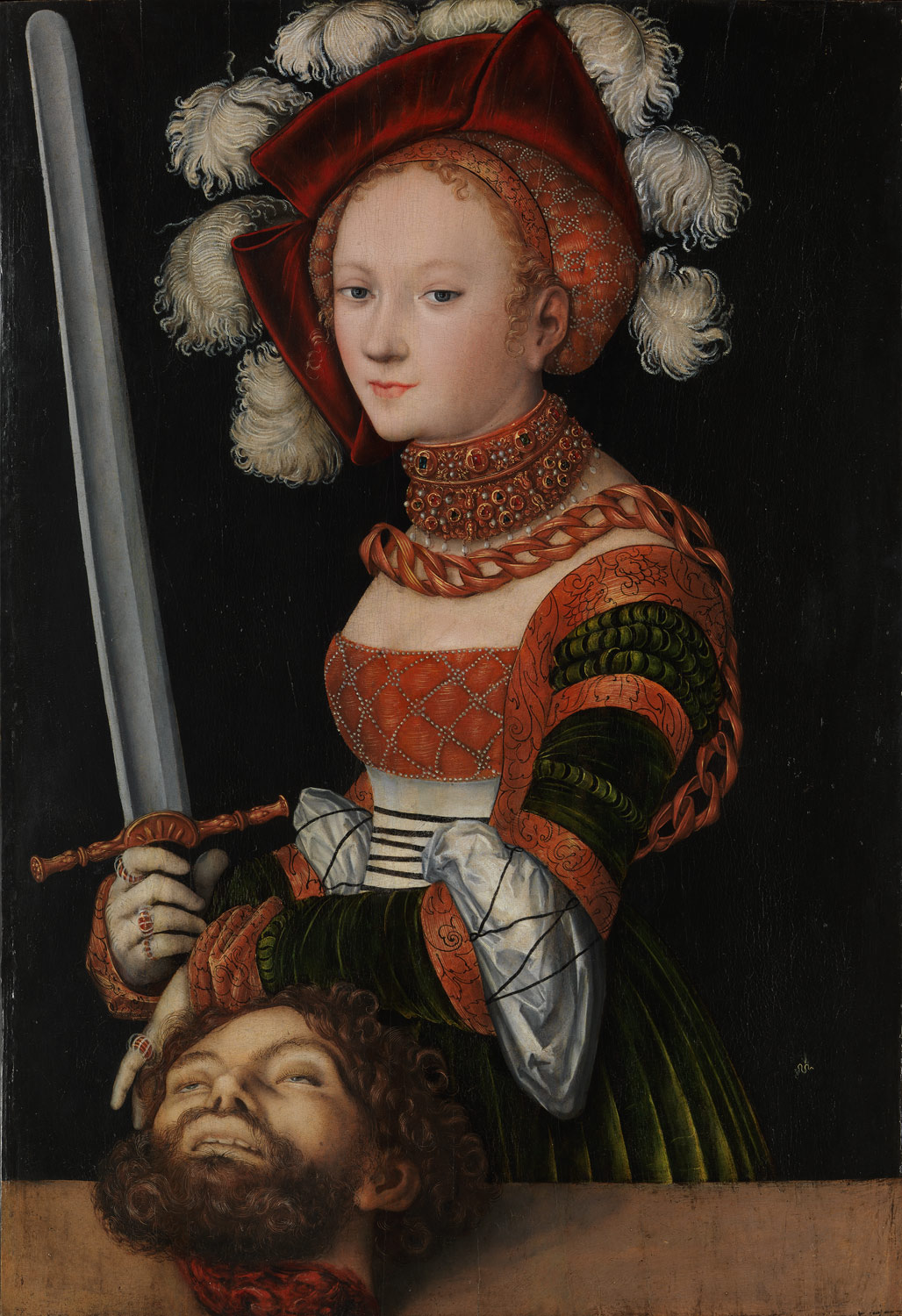
Lucas Cranach was a pre-eminent German painter, a canny businessman, and a public relations maestro, who bestowed his own luxury-brand logo on all his works – the symbol of a serpent.
He lived in turbulent times, when the line to tread in depicting religious subjects was a thin one. During intense spiritual upheaval across Europe in the early 16th century, art had become central to the prevailing unrest.
Waves of ferocious anti-Catholic feeling resulted in many altars and church frescoes being destroyed as idolatrous. Art was re-purposed, with a new austere visual language used as a tool for publicising protestant values.
Cranach (1472-1553) was at the heart of this movement as a close friend of Martin Luther, the founder of Protestantism. His paintings of religious scenes and his portraits of the mighty became fundamental in establishing a new vision of Christianity. It was deemed as providing a direct representation of the true gospel, doing away with heretical Catholic ostentation.
Cranach was instrumental in flooding Europe with imposing portraits of Luther himself, also producing engravings for the front of his pamphlets. The artist saw the reproducibility of pictures as key to their composition and technique; he was trained in engraving, seeing it grow in stature since the invention of the printing press.
Cranach’s illustrations of Christ and his apostles as impoverished prophets were deliberately set against the pomp and materialism of the Pope. It was a swingeing, incendiary attack on the Catholic Church, and widely distributed across many nations.
Luther was a valuable friend for an artist at the time. His doctrine made depictions of holy subjects acceptable, provided it was emphasised that these were just images, and not objects of worship in themselves.
Cranach soon began to paint religious paintings for Protestant clients; however, he shrewdly also managed to maintain his Catholic customer base. He completed Catholic commissions, even altarpieces for the cathedral of Luther’s chief adversary, Cardinal Albrecht, archbishop of Mainz.
Is his Judith with The Head of Holfernes, from 1530, a Catholic image, or a Protestant one? The ancient tale of Judith and Holofernes is certainly titillating, an ultimate biblical demonstration of the battle of the sexes. It appears that the Israelites were facing attack by the formidably larger army of the Assyrian King Nebuchadnezzar, led by General Holofernes. The Israelite leaders decided to present the problem before God, leaving him five days to save them.
Judith, a most attractive widow, was dissatisfied by this plan to test the Almighty, and took matters into her own hands. Stealing out of town she approached the surrounding Assyrians, and spinning a web of supposedly vital military secrets, she offered Holofernes detailed information about Israelite defences.
Holofernes was clearly intrigued, and captivated by her beauty invited her into his tent. Judith seductively plies him with compliments, and much wine, and when he passes-out intoxicated, she beheads him.
Returning to her people a heroine, she leads the surprise attack on the Assyrians and roundly defeats them. The story is reminiscent of Samson and Delilah, one of a number of religious tales in which a woman has paradoxically lied to defeat an enemy; lying may be a sin, but when employed by a seductive woman, with God’s blessing, it is clearly a persuasive tool.
Despite Judith being portrayed as an aristocratic princess with all the glittery showiness of a Catholic depiction, it was accepted as a fitting one for a Protestant narrative. The smaller Israelite state, defeating the power of the Assyrian forces, was seen as mirroring the embryonic Protestant movement in its conflict with the mighty Catholic Empire.
The subject has been portrayed differently over time. Early versions showed Judith as a figure evoking the Virgin Mary. Later, in Caravaggio’s moodily cinematic depiction of Judith as a femme fatale, she is violently severing the screaming Holofernes’ head from his body. Pictured in characteristically dramatic lighting, a red jet of blood squirts out in the manner of a samurai movie. Cynically, Caravaggio includes the haggard crone of a maid standing beside Judith, his glimpse at the endgame of feminine charms.
In contrast, Cranach offers a rather more poised, restrained and metaphysical vision. Captured in the moment after the beheading, Judith poses for the viewer in satisfied triumph, as if standing on a podium.
Luther viewed the picture as a poetic, allegorical passion play. Judith is calm and composed, despite having just removed Holofernes head from his shoulders. This suggested that she was possessed by God in order to perform the act, alleviating the viewer from supposing that Judith, or women in general, are powerful in themselves. She is fully clothed, decorous, and bejewelled, all modesty firmly intact – but her material sumptuousness, and cinched-in corseted waist renders her slightly less than virginal.
Clearly, something in the story seems to have obsessed Cranach, or perhaps he was responding to growing demands for further depictions of the scene – he made 18 different versions of this picture. In each Judith is a courtly presence. Sometimes her hair flows down her shoulders coquettishly, in others it is tied back. The positioning of Holofernes’ head changes a little, as if Cranach is searching for the perfect vision of female allure triumphing over its enemy.
The Metropolitan Museum in New York note that their transcendent version of the painting, seen here, employs ‘typical systematic methods used by the artist, which were designed to facilitate rapid manufacture and ease of reproduction’. The singular brilliance of this work is perhaps somewhat undermined by this statement.
In truth, Cranach’s studio was churning out paintings for the nobility across Europe, alongside heraldic devices for tournaments, table ornaments for banquets, shields and crests for ducal coaches and banners. Nonetheless, Cranach’s magnificent portrayal of Judith is best understood as having been created in times of both restraint, and religious fervour.
It majestically towers astride theological iconography, and a sensualist vision of female erotic power.