
The Naked Maja
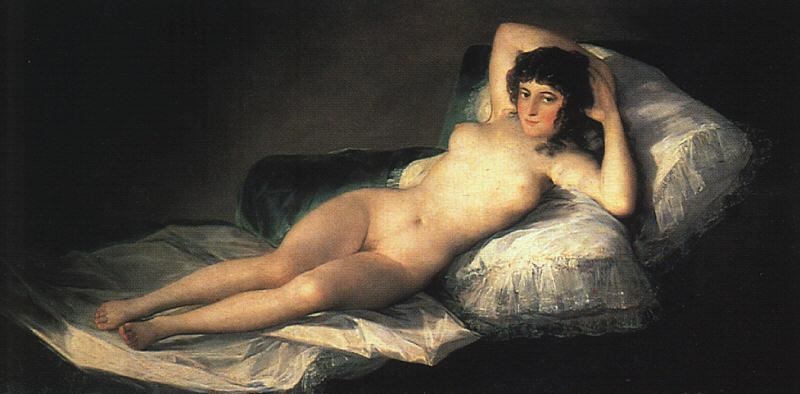
Francisco Goya was born when Spanish art was at a low ebb. The genius of Velázquez had been followed by generations of anaemic mediocrity. In 1760 when Goya was fifteen, he was passing his time sketching in the fields near Saragossa. A monk was walking slowly by, reciting his breviary, when he came across young Francisco making his charcoal drawings.
Struck by the youngster’s aptitude he immediately asked the boy to take him to speak to his parents. It took little persuading to allow the monk to use his ecclesiastical connections to help Francisco enter an apprenticeship with a prominent studio. In all possibility, that fortuitous meeting awakened the latent brilliance of the artist and ushered in the renaissance of Spanish painting.
Goya was an intensely keen observer of humanity, using his brush and pencil to tell the vivid stories of the people of Spain, and the restless life of the city.
His representations of women were endless and all encompassing. Covens of witches, beautiful maidens, mistresses of powerful men, milkmaids, gypsies.
However, none of these portraits was to prove more notorious than Goya’s La Maja Desnuda, The Naked Maja. Goya misappropriated the traditional stoically frigid representations of the female nude. Instead, inspired by Titian’s audacious Venus of Urbino that had so horrified 17th century Italy, Goya went further – abandoning any niceties or suggestion that he was innocently portraying a Goddess.
He wanted anyone looking at his naked model to be fully aware that here was a woman of the lower classes, a ‘maja’, a person considered a lowly commoner in Spanish society. This is no Divinity basking upon the canvas here, rather a woman of the people. The Naked Maja presents a highly sexualised, almost aggressive female gaze, staring back at the viewer directly and provocatively.
Until now, tradition dictated that a female nude would coyly glance away, allowing detached admiration at the sight of her naked body, but not engaging. Here, the steady focus of her eyes denotes the model’s fiery participation.
Goya has made every effort to emphasise her sexual virility for the pleasure of his audience. The model’s face is fresh and glowing; her skin milky and sensuous. The artist left no detail to the imagination, even depicting the nude’s pubic hair.This alone would have caused a general scandal, its inclusion being entirely unprecedented in Spanish painting.
Strategically, choosing a maja as the subject of a portrait meshed with Goya’s own political alignments, although he was far from leading the life of a typically struggling artist. Goya’s career began to escalate at the age of twenty-nine, when he was initially commissioned to design vast church tapestries. When Goya relocated to Madrid, he continued to produce these large, crowd-pleasing religious works, consequently coming to the attention of the Spanish monarchy.
The newly appointed Carlos IV and his Queen, Maria Louisa, became ardent patrons. It seems that Goya knew how to play the political charades that accompanied the career of a successful artist within the Spanish court.
It is only in Goya’s later works that we sense his inner discomfort, and the strong affinity he felt for the ordinary citizens of Madrid and Spain.
Goya’s distaste for the aristocratic class, that he was so dependent upon for advancement, was to cast an acidic shadow over much of his work.
La Maja Desnuda was in fact a representation of Pepita Tudo, the courtesan of the Spanish Prime Minister Manuel de Godoy. The work was initially completed for Godoy’s private collection, remaining hidden behind silk curtains in his palace for his own personal enjoyment. But with the dawn of the Spanish Inquisition, the prying religous powers doggedly aimed at bringing down a meaningful target; Prime Minister Godoy was in their sights, and vulnerable in view of his many sexual indiscretions.
Unfortunately for Goya, his image came under intense scrutiny, and he had to justify in specific detail his exact motivations for the production of La Maja Desnuda. He explained that his work had evolved from traditionalist roots, the artist simply aligning his painting with Titian’s Danae series and Velázquez’s Rokeby Venus. Goya claimed that the work merely acted as a tribute to the classics, which had been previously approved by the papal authorities. The painter’s further interrogation was forcibly quashed by his supporters in the Royal court, saving him a daunting public inquisition.
In 1792 Goya had been struck by a severe illness which left him virtually deaf, and the effect this would have on his work was profound. He used his art as a jaundiced commentary of humanity – the follies, weaknesses, vanities, cruelties. And now that Goya’s vision could finally free itself from the constraints of its era, soon he was able to begin his most eviscerating work.
Devastatingly, he pictured the horrors of war. Captured in stark realism, these works are a heartrending indictment of man’s inhumanity, with many condemned as too disturbing to be seen by the public for forty years.
Goya now lived in isolation on the outskirts of Madrid. He began to create The Black Paintings, never to be named, or explained. They were simply the darkest imagery ever portrayed by an artist – the Roman god Saturn devouring his children in case they should grow up to one day usurp him; a simple picture of a dog drowning; two prostitutes laughing at a man who is masturbating.
The pictures represented the purest form of artistic self-expression, coming solely from the artist’s mind, uncommissioned, not aimed at any buyer, painted entirely for himself. No body of work is more hauntingly bleak, more resonant of the frailties and failures of the human condition. Although not intended to be seen by others, these paintings were vital and relevant enough to electrify viewers forever.
For generations of artists to come, Goya would be a primary inspiration, always to be considered a century ahead of his time. Little wonder that he was to be most memorably described as the ‘most radical artist that ever lived’.