
Gare Montparnasse – The Melancholy of Departure
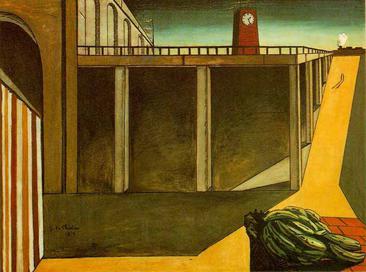
Unsurprisingly, Georgio de Chirico was the idol of the Surrealists.
His invention of ‘metaphysical painting’ in 1910 transfixed the coming generation of artists, including Dali, Magritte, Ernst, Man Ray, who were intrigued by dreamlike imagery.
Although his career spanned 70 years, de Chirico (1888 -1978) would never produce any work that was more significant than the paintings he produced in that early decade.
Sadly, he seemed to agree with this view, as he would eternally create new versions of this body of pictures, and routinely back-date them. His reputation, and the market for his art, suffered terribly.
It also hurt his role as a torchbearer for the Surrealists when he eventually tired of being courted by them. He wanted to distance himself, and referred to them as ‘the leaders of modernistic imbecility’. This did not sit well with their spiritual mentor, the influential André Breton.
De Chirico’s extraordinary painting from 1914 Gare de Montparnasse – The Melancholy of Departure neither refers to a specific place, or a particular view. It is more reminiscent of a theatrical set, an imaginary backdrop for an event drawn from his imagination, and certainly not a familiar cityscape.
The overpowering olive-grey concrete building on the left of the composition has columns and arches partly suggesting the Parisian railway station, but it is juxtaposed with geometric planes and surfaces, with the inconsistent perspective creating a disquieting sense of unease.
The plaza is empty except for murky shadows, adding to the oddly disturbing atmosphere, with the viewer unclear whether it is dawn or dusk. The clock face reads 1.27, further increasing the confusion.
In the distance, at one of several vanishing points in the picture, is the silhouette of a train puffing away as it crosses the horizon. Under the yellowy green sky, an exaggeratedly steep ramp seems to run from the train directly to the foreground; two tiny figures are standing far in the distance high on the ramp, with elongated shadows.
Somewhat bizarrely at the bottom right corner of the painting, de Chirico has painted a bunch of bananas, inexplicably sitting on a surface of red bricks. Their size is disproportionately large, deliberately emphasising their peculiar inclusion in the picture.
Once exhibited, the painting reverberated across the art world like a clap of thunder. He tried to explain his work by stating; “I paint what I see with my eyes closed.”
Or perhaps, he was just feeling a little homesick. Born in 1888, he was raised in Greece to Italian parents, and his childhood memories of being an outsider, wandering in shadowy, empty town squares may have ingrained themselves on young Georgio. He had grown up surrounded on all sides by looming buildings, with their menacing-looking gargoyles, and mysterious statues staring down every few steps.
His first works were clearly inspired by his fixation with the classical antiquities of Greece and Italy, and his philosophical studies of Nietzsche and Schopenhauer.
Paintings like Enigma of an Autumn Afternoon depicted his early obsession with lonely, dramatically lit piazzas, punctuated by a single figure or monument. His work was already utilising stark perspective shifts, and unsettling jumps in logic, with his frank, realistic method of painting allowing him to depict objects with great simplicity.
By the time he arrived in Paris in 1911 he had perfected his new ‘metaphysical’ approach, and found himself welcomed by the avant-garde artists working there, including Picasso and Brancusi.
His work was well received, particular the enigmatic town square pictures like The Enigma of an Autumn Afternoon. The Parisianart world was struck by the eerie tension he was able to create in this painting within a simple scene of solitary child playing with a hoop.
The strange artificiality of his cityscapes, the severe, oppressive architecture, the sinister shadows that filled the type of haunted streets you would encounter only in dreams, and the inexplicable perspective idiosyncrasies he would employ in his compositions, all made an unforgettable impact.
De Chirico soon raised the stakes higher by featuring increasingly illogical commonplace objects like rubber household gloves, maps, and fruit, alongside images of faceless mannequins.
The dissonant mood was an inspiration to a group of artists who were becoming deeply involved in attempts to reflect the subconscious mind. They sensed that de Chirico’s work was opening doors – and were fascinated by the opportunity to experiment with the new theories of dream analysis and interpretation.
The birth of Surrealism grew out of this this single notion – that it was possible to instill hidden significance to quite ordinary places and objects. As de Chirico explained “To become truly immortal a work of art must escape all human limits: logic and common sense will only interfere. But once these barriers are broken it will enter the regions of childhood vision and dream.”
But De Chirico was instinctively more conservative than the thrusting new wave artists, and by the late 1920s began to move away from his radical earlier work. He switched to a neo-traditional style that embraced Renaissance and Baroque roots; this of course alienated his supporters, and the critics who had championed him.
Notwithstanding the hostility, he continued to explore his infatuation with Raphael and Titian, and a renewed belief in the value of craftsmanship. He wanted greater detail in his new paintings, with richer colour, and more accurate renditions of form and volume.
Almost immediately his ties to the avant-garde were severed. His career was sidelined, his work was inconsistent, and generally ignored. When his back-dated versions of his earlier work infiltrated the market, his reputation was irretrievably soured. And the Surrealists had not forgotten the barbs of his hurtful public snub.
However, the influence of his astonishing early works cannot be overlooked. The art world may have not forgiven his follies, but nonetheless these visceral paintings remain a vital legacy. Their imagery has been directly referenced over the decades, memorably in legendary film director Michelangelo Antonioni’s enigmatic, desolate city scenes, and more prosaically, on the packaging of Playstation videogames.