
Woman with a Parasol
At his secondary school, Monet (1840-1926) discovered that his charcoal caricatures were popular, and that he could sell each one for 20 francs. He soon decided he might do better taking drawing and painting lessons, and becoming an artist, rather than following his father’s wish that he join the family grocery business.
Like so many painters, Monet moved to Paris early on in his career. There he saw artists sitting in the Louvre in front of the Old Masters, painstakingly copying and trying to learn from these revered classical works.
Instead, Monet chose to sit by the window and paint the view he saw, beginning to create his own approach. He started to work outside, en plein air, learning the fundamental techniques from his tutor Eugène Boudin. It was his ability to master the effects of light on his subject, and his skill in magically capturing it, that were to define his career.
Looking at the serene pictures created by Monet over his lifetime, you would be forgiven for thinking that he lived a very quiet life, spent mostly on the banks of ponds filled with lily pads, or at picnics on idyllic beaches with friends.
For the most part, you would be correct, but Monet also enjoyed life as a vigorous young student artist, and threw himself into the swing of Parisian life, taking advantage of all it had to offer.
Monet viewed art school with the same disdain that he felt for the artists he had earlier seen in the Louvre, meticulously trying to copy the masters. He became disillusioned with traditional art, both the way it was being taught, and the work that was being created around him. Instead, he found inspiration in his circle of friends that now included Pierre-Auguste Renoir and Alfred Sisley.
Together, they shunned conventional methods and subjects, and bold new ways of making art started to be grounded.
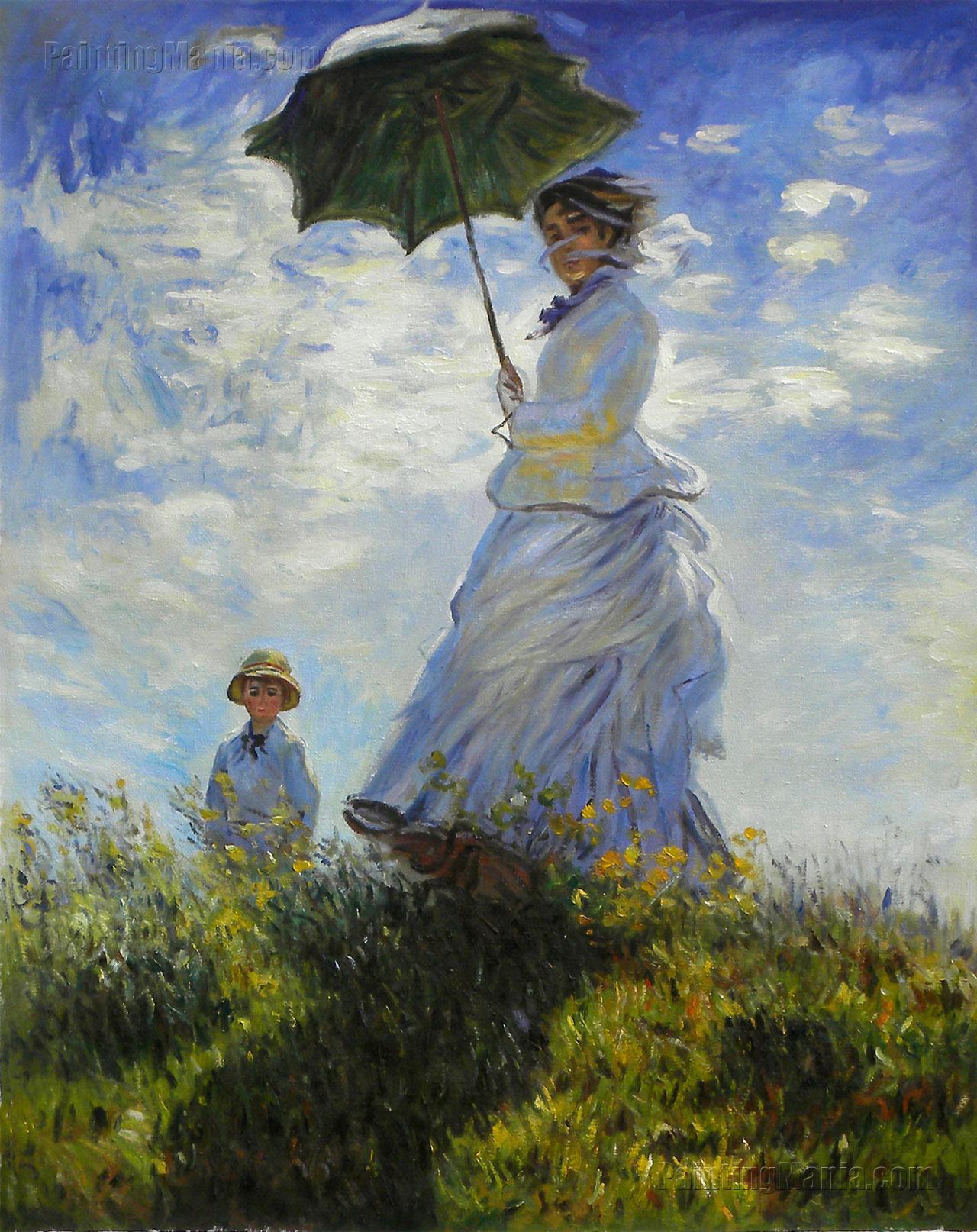
Monet had many years to hone his skills before he painted Woman with a Parasol in1875, a tender painting which depicts his wife Camille, whom he had met when she had posed for him in Paris, and their son, Jean. Monet’s way of working – a remarkable use of colour to convey the moment in time when light is fading – is exemplified in this one painting. Camille’s veil and dress billow in the wind, echoing the surrounding grass, the image perfectly capturing the sense of a family stroll in the late afternoon.
However much this might seem like a delightful portrait to viewers today, it was far from the typical genre painting that many of Monet’s contemporaries would have expected – indeed it was considered downright rebellious.
Monet and his fellow artist friends submitted their works to the Académie des Beaux-Arts to be shown at their annual exhibition at the Salon de Paris. This was the most prestigious event on the art calendar, and they all regularly faced total rejection.Their work simply did not fit with the very conservative style which was favoured by the Académie. In response, in 1874 the artists decided to form their own renegade group called the ‘Société anonyme des artistes peintres, sculpteurs et graveurs’ so that they could exhibit their own work.
Monet, Renoir, Pissarro, Sisley and their colleagues had broken the steadfast rules of painting, and wanted to show the public what could be created beyond the restrictions being imposed on art by the establishment.
It was at one of these exhibitions that a critic, on seeing one of Monet’s pieces, scornfully coined the term ‘Impressionists.’ He felt the pictures seemed unfinished, as if the artists had only managed to create mere impressions. But the group now had an identity; they were now a movement!
Monet showed Woman with a Parasol at the second exhibition hosted by the rebels of the art world. Despite lacking popularity – viewers were uncomfortable with pictures that strayed from familiar classical themes – Monet persisted. He continued with his painting style, his technique, and his favoured subject matter, often painting the same scene over and over again, in order to study the light as it changed during the course of time.
Monet would often get frustrated with the results after weeks of work on a painting, and destroy it. This happened so frequently that over five hundred of his pictures are estimated to have been trashed – kicked, slashed, or burnt; the offending pieces would be removed from sight instantly. He suffered from grave self-doubt, and was even upset that his friend Manet seemed annoyed that the two of them could be confused because of the similarities of their names.
Monet regularly travelled to find inspiration, and in the early 1890s rented a room opposite Rouen Cathedral in north western France. He wanted to capture the building in a variety of conditions – morning light, midday sun, grey weather – as many as twenty paintings studying the changing effects during the day.This fascination with variable light drew him to produce many studies of haystacks, poplar trees, and he even visited London to paint the River Thames in various weather. In Giverny, he loved the gardens that he had helped create there. The Japanese-style bridge over the garden’s pond became the subject of many works.
However, despite Monet and his fellow Impressionists garnering attention, it was not turning into profit. Monet was making a name for himself, but he was continually in debt. He nonetheless persevered in his approach, refusing to stop even when he was diagnosed with cataracts.
Monet had to wait to be an old man to finally see his work recognised and generally admired.
Today of course we can all see what he was fighting for, and can only be thankful for his resilience.