
The Swing
It is certainly the case that Jean-Honoré Fragonard (1732-1806) is most renowned for his depictions of saccharine, congenial images of the upper classes at play.
He was undoubtedly at his prime in the late Rococo era, a time synonymous with hedonistic freedom, and the pursuit of all things pleasurable and aesthetically agreeable.
The style emerged in France during the mid 18th-century as a reflection of the gaudy embellishments that were now so popular in architecture and furniture. They were considered exceptionally stylish by the bourgeoisie and newly wealthy, who sought paintings that demonstrated their refinement, as they surrounded themselves with all that was resplendent.
The pinnacle of full-blown Rococo style was the extraordinary Palace of Versailles, which soon came to be seen as the epitome of decadence, and vulgar grandeur.
And then, the French Revolution arrived – bringing with it a brutally robust finale to the era of excessive displays of opulence
Fragonard was never destined to be just a simple painter of landscapes or classical scenes. From a young age, he led a charmed life. Born in 1732, he moved with his family from the South of France to Paris, where even as a boy his drawing abilities soon gained attention.
His talent led him to be introduced to the outstanding Boucher, who although impressed with the young boy’s abilities, was reluctant to take on someone so very inexperienced. To solve this problem, Fragonard was sent to apprentice at Chardin’s studio, where he spent six months studying the artist’s masterly technique and sublime still-life painting.
He returned to Boucher fully equipped. In fact, he was now so able, he could adopt to his master’s methods quickly and accurately. In little time young Fragonard was entrusted with executing replicas of Boucher-style paintings.
Despite not being a pupil of the Paris Academy, Fragonard still managed to win the Prix de Rome in 1752 with his picture Jeroboam Sacrificing to the Golden Calf. As a result he spent the next three years studying at the French Academy in Rome. He toured Italy, in trips were to be of seminal importance to the highly-gifted artist Fragonard was to become.
He made countless sketches of local scenery, of the romantic gardens, grottos, fountains, terraces and temples around the country, that would later be incorporated into Fragonard’s art. He also grew to admire the masters of the Dutch and Flemish schools, and began to imitate their loose and vigorous brushstrokes.
In 1765 Fragonard finally earned his place at the Paris Academy with the exquisite Coresus et Callirhoe, and promptly, the young painter would make a name for himself among the aristocratic set.
Whereas he had previously dithered between subjects that were religious or classical, the new demands from members of Louis XV flamboyant court meant that Jean-Honoré’s work took a clear new direction.
Focused solely on his clients’ most coveted subject matter – faintly licentious scenes of love and voluptuousness – these became the pictures he would be forever associated with. But he managed to still produce magnificent paintings within this unlikely brief, with a tender use of colour and delicate brushwork to convey an atmosphere of intimacy and veiled eroticism.
Behind these images created by Fragonard, he seemed to live a tranquil life. He married a painter of miniatures, Marie-Anne Gérard, and had a daughter, who was to become one of his favourite models, and later, a son.
With the birth of his children, and as Fragonard aged, the focus of his painting began to shift towards more domestic scenes. The lavishness of the court of Louis XV had come to an abrupt end after the French Revolution, and with it disappeared Fragonard’s primary customer base, and his reputation.
He moved into the house of his cousin, which he decorated with the delightful series of panels known as Les Progrès de L’amour dans le Coeur d’une Jeune Fille.
Despite the popularity he had enjoyed early in his career, Fragonard was to die in relative obscurity, almost entirely overlooked, his work ignored for half a century.
Today he is recognised as the foremost of French Rococo artists, and perhaps more importantly, as an unmistakable influence on the Impressionists, notably Renoir, and Fragonard’s grandniece, the great Berthe Morisot. His handling of colour and his expressive feathery brushstrokes can be traced directly to their work.
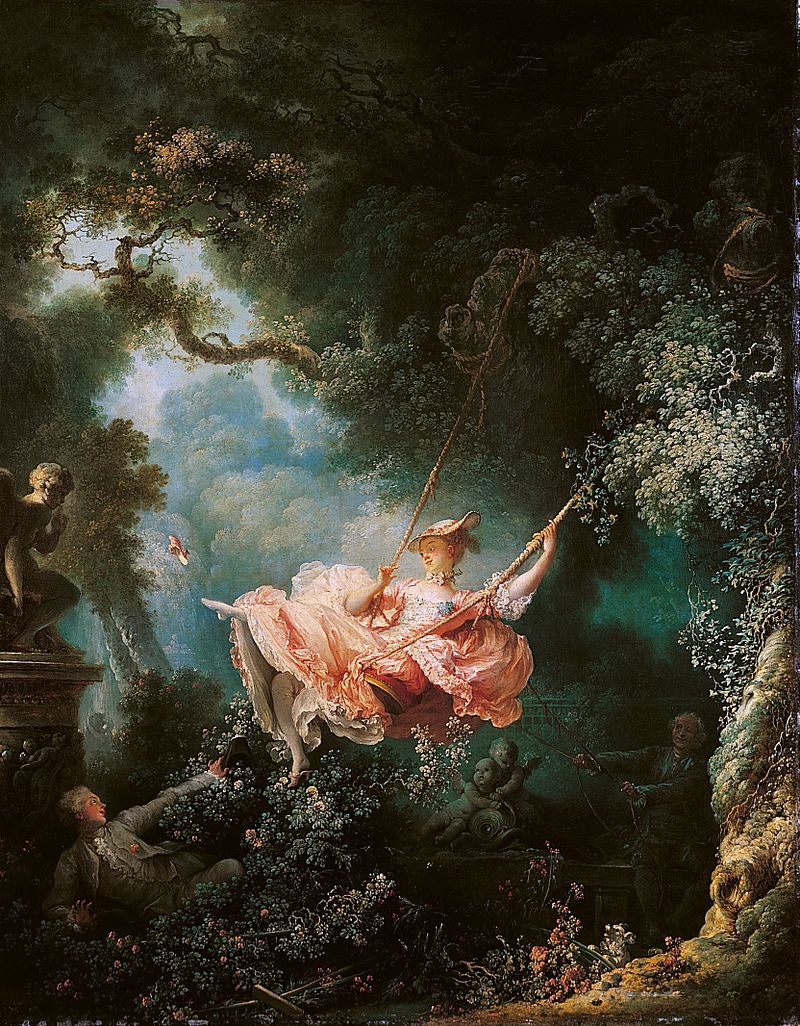
Throughout his lifetime, Fragonard produced around 550 paintings, only five of which are dated. However, he is possibly most admired for The Swing from 1767, now housed at the Wallace Collection in London.
Originally titled The Happy Accidents of the Swing, it is considered one of the fundamental masterworks of the Rococo era. A young woman, dressed in a billowing and fanciful pink dress, sits on a swing while being pushed by her spouse.
She is the very essence of frivolous abandon, from her frilled dress to her shoe flying off her foot through the air. A young gentleman watches, concealed in the bushes, and gets a glimpse up the woman’s skirt as she swings forward; her husband is blindly unaware of the affair going on between the two.
It is a particularly engaging demonstration Fragonard’s skills, making a simplistic scene of idle pleasure into a painting of such charged magnetism.
The work was commission by the notorious libertine, Baron de St. Julien as a portrait of his young mistress. Other artists were nervous of getting involved, but Fragonard leapt at the opportunity. He was given the specific instructions for the picture by the Baron: ‘Place me in a position where I can observe the legs of this charming girl’.
The painting is rich with symbolism – two cherubs below the swing appear unconcerned about the somewhat salacious actions taking place above, while a statue of Cupid to the left raises a finger to his lips, indicating the secrecy of the illicit relationship.
In many ways, the piece is a perfect summation of the Rococo movement – it depicts a moment that seems almost fleeting, but idyllically captures the aristocratic frivolity and high spirits of its time, before disaster struck.