
The Death of Sardanapalus
There is still debate about the identity of Eugène Delacroix’s father, both possible candidates having been powerful political figures. What is certain is that despite being born into privilege in 1798, he was fortunate to survive his supposedly pampered infancy.
Left permanently in the care of nannies and housekeepers he was once almost burnt to death when his sleepy nurse overlooked a candle falling into his crib. Young Delacroix was left close to death and permanently scarred.
Another of the nannies entrusted to the baby’s care dropped him into the ocean; as she leant over the side of a docking ship to embrace her lover, the child slipped from her arms. The infant was also once accidentally poisoned, nearly choking to death.
Yet despite these brushes with calamity, Delacroix survived to become one of the vital inspirations of the French Romantic movement.
His supposed father, Charles-Francois Delacroix served as the Minister of French Foreign Affairs, and had supported his creative studies. The young artist slowly secured himself a solid reputation within the Salon de Paris, and his paintings exploring the Greek Wars of Independence in works such as The Massacre at Chios were well received.
Yet the dramatics of his infancy seemed to haunt Delacroix like a dark shadow. There has been much argument about the legitimacy of Charles-Francois Delacroix’s paternal claim over the artist – he was said to have been infertile at the time of Eugène’s conception. Instead many historians argue that Charles Maurice de Talleyrand-Perigord was the artist’s biological father. Talleyrand himself is a figure of intrigue; a French bishop, politician and diplomat, he strongly divided historians and academics about his role in the French Revolution.
One perspective portrays him as a trusted and integral agent of the French government, the other a Machiavellian traitor. Yet one fact remains clear: he always protected Delacroix, helping to secure his reputation as an admirable painter amongst diplomats and aristocracy.
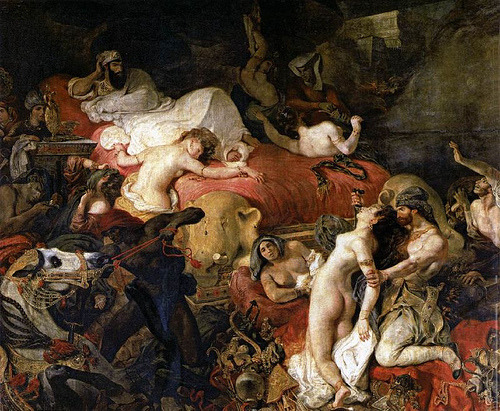
Only one of his paintings was not purchased by the state: The Death of Sardanapalus.
Sardanapalus has featured time and time again in mythology and legend, most often to illustrate notions of corruption, sloth and debauchery. The last Assyrian king, he was believed to have reigned around the 7th century BC and was notorious for his hedonistically excessive lifestyle.
The painting is lavishly sumptuous in its treatment of colour and texture, depicting Sardanapalus lying down in his stately chamber, at the moment when his armies had been conquered by the advancing enemy.
The scene is grotesque – writhing naked bodies of Sardanapalus’ concubines, his servants and even his prize horses, all of whom are being slain, to die with their defeated king.
The free, expressive brushstrokes and the lush treatment of the nightmarish subject matter contrasted greatly with the painterly norms of the day. Delacroix had eclipsed Neoclassicism, which routinely tended towards an orderly, academic discipline of form and sense of realism, following a grid-like precision.
The Death of Sardanapalus, painted in 1827, is far more than a simple exercise in storytelling and narrative. At first glance, the immense canvas appears to exemplify the notion of Orientalism, which was so prevalent in 19th-century painting.
Napoleon was taking an active interest in the efforts of the Ottoman government to reform and modernise itself; realist painting became a propaganda tool through which the culture and history of the Orient could be diminished, substantiating the ambitions of the French to control the region.
Other important paintings at the time provided an almost anthropological sense of realism; in truth, many of the artists had never left Europe. Jean-Auguste-Dominique Ingres’ Grande Odalisque, suggesting a concubine within a harem, encouraged the viewer to associate untethered sexual misconduct and corruption within the imagined Orient. However the work as a proselytising device is undone by its own hypocrisy; the concubine – apparently representational of Eastern culture – is in fact European, with pale, translucent skin.
Yet Delacroix by comparison treated the notion of the Orient with more respect and neutrality. Preceding The Death of Sardanapalus, Delacroix had travelled to Morocco, Algeria and Spain, and his sketches from that time covered all areas of life; we see market places, landscapes, seascapes, women and children dressed in traditional attire, families gathered in their living rooms. Delacroix developed an almost childlike enthusiasm for discovering how others lived, completely alien to the stuffy formality of the Salon de Paris.
But importantly, rather than supporting political expectations of this era, The Death of Sardanapalus seemingly undermines them. It was argued that the picture was not commenting upon the flaws of the Orient – it instead diminished the relevance of sovereignty to a newly restored France. Although Sardanapalus is a character featured in legend and mythology, his representation within this scene reaffirmed the link between royalty and chaos in the French consciousness.
It was certainly noted that the mighty king remained detached and apathetic in the midst of the horrors surrounding him. Delacroix’s use of perspective and composition is loose and free-flowing, far removed from the orderly tightness of his predecessors.
Predictably, the painting was very poorly received. Delacroix had fallen out of favour with the Salon, the inherent brutality and cold-bloodedness of this piece perhaps hitting too close to home politically. Its indoctrination potential amounting to nothing beneficial, and The Death of Sardanapalus was not acquired by the authorities, remaining hidden from view in the artist’s studio.
It was only brought to light again when the Louvre purchased it in 1921, over 50 years after Delacroix’s death, where it is now simply read as a painting of a fabled minor moment in history.
However, the vast work itself is such a tremendous achievement, it transcends any political baggage it may have once carried.