
Broadway Boogie Woogie
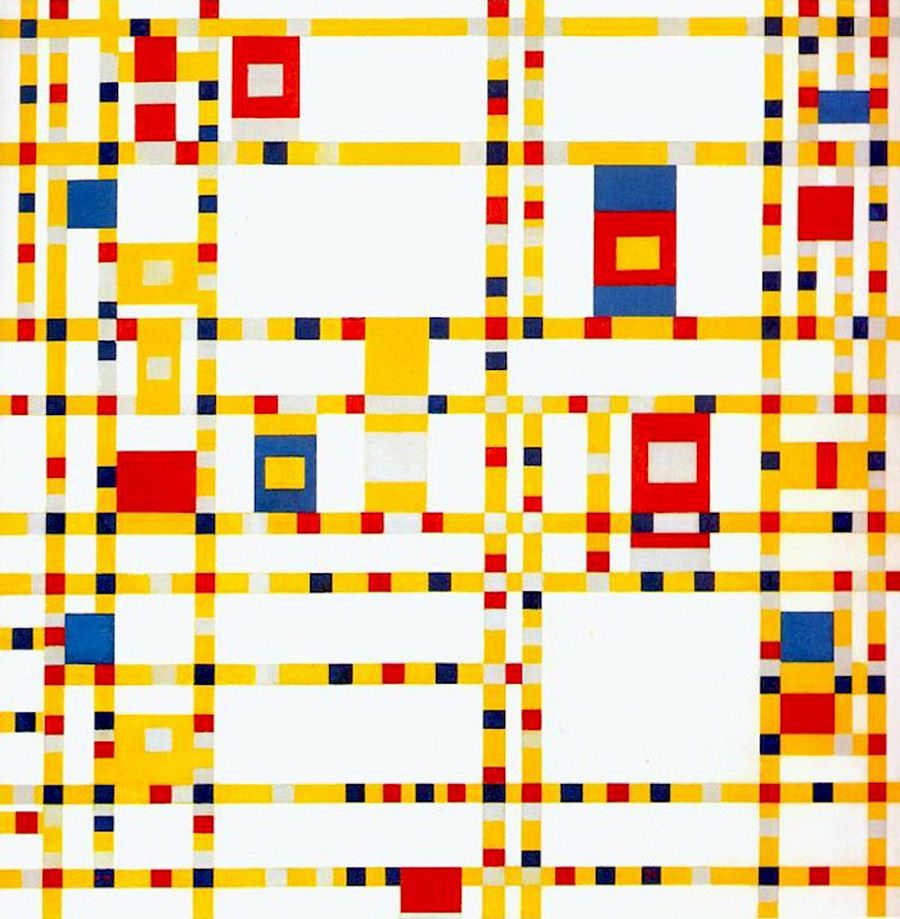
Mondrian’s distinctive abstract canvases came to propel the modernist movement towards pure geometry, distilling form into colour and line.
Mondrian’s (1872-1944) success as a painter was by no means evident in his young life. In 1909 he failed to qualify for the Prix de Rome, the most distinguished artistic prize in the Netherlands, and his style remained mired in the aesthetics that had already been pioneered by other painters of the Impressionist and Post- Impressionist schools.
His studies in Amsterdam had not led to much progress in his work, Holland at the time being a conservative backwater in terms of artistic achievement.
Nevertheless, he clung so ferociously to his Protestant beliefs many described him as having a ‘priestly’ air. Spirituality was to become a focus of Mondrian’s life; he joined the Dutch chapter of the Theosophical Society, a group that were proselytising their conviction about the unity of man and matter, earth and cosmos.
Many believe Mondrian’s move from figurative painting, in the vein of the impressionistic style of the day, to abstraction, was in much part a result of his discovery of Theosophist values. Led by the enigmatic and mysterious Madame Blavatsky the Theosophical Society was, and remains today, an occult group that believed in hidden masters or advanced spiritual beings, who oversee the evolution of humanity.
Faced with the decision of whether to leave the Netherlands for Paris – then the melting pot of artistic activity – Mondrian turned to a distinguished astrologer and theosophist Adriaan van de Vijsel for the answers, commissioning a birth chart that would reveal the best way forward. His move was a seismic moment in his career, marked not least by his change to the spelling of his name, from Mondriaan, to Mondrian.
Once in Paris, Mondrian was able to concentrate on the new influence of Cubism, a style that he had only recently become aware of. Living in the exciting hub of new art in the French capital brought about a flowering of his work, which nevertheless came from periods of intense isolation, of an almost mystical quality.
He had very few friends, preferring to spend time locked in his studio – the very epitome of the tortured and isolated artist. ‘He was very reclusive and I think that the reclusiveness was part of his feeling that he simply had to save everything for his art,’ wrote John Golding.
This is well illustrated by ELT Mesens, the Belgian Surrealist, who met Mondrian in Paris in the 1920’s, and told of taking young Piet to lunch one Saturday. They had plenty to drink, and after lunch Mesens keenly urged Mondrian to accompany him to a brothel.
Mondrian declined, saying, ‘every drop of semen spent is a masterpiece lost.’
Sadly, much of Mondrian’s relationship with women was marked by failure – affairs which were always cut short, one or two broken engagements. He deeply missed having a woman beside him to share his life. He always kept a flower – a single rose suggesting a feminine presence – in the small vase on the hall table of his studio at the Rue du Départ.
Mondrian did not lack a certain attraction for women. But unfortunately, most soon found him impenetrable, and his ascetic air wore them down, as did his desire to eat only currants and vegetable stew.
His work began to develop towards the full flow of abstraction as a member of the De Stijl movement. Mondrian fashioned a studio that would be more of a public space than before, and clearly embraced his new sense of freedom.
The room on the Rue du Départ became renowned as an extension of his new paintings, squares of vivid colours covering the walls and floors, geometric furniture and his canvases providing a perfect backdrop for gatherings of fellow artists, collectors, gallerists, and even journalists who would photograph him in front of his easel.
The studio became an extension of his work, a forceful reminder of the ways in which Modernism sought to permeate every area of life, rather than remaining solely in the province of art.
Mondrian escaped the onslaught of the next World War by moving to London – his paintings had been included in Hitler’s Degenerate Art Exhibition in Munich, 1937, and he was very concerned that the Nazi occupation would bring dangers for him.
Housed in Hampstead, Mondrian seemed to have left behind the sternness that had characterised him in his earlier life, settling into the artistic milieu of London at the time, with figures such as Ben Nicholson, Barbara Hepworth, and Peggy Guggenheim.
Mondrian was very taken with the Disney cartoon of Snow
White, released in 1938. He wrote to his brother in the Netherlands that his landlord ‘has had my room cleaned by
Snow White, and the squirrel has whitewashed the walls with his tail’.
Clearly, Mondrian had become a very different person to the austere young man he had earlier been, steeped in his devout Calvinist upbringing.
After the Blitz got underway, and he was showered with glass when a bomb fell near his house, Mondrian hurriedly managed to get a visa and moved to New York. It was here that he painted one of his last great canvases, Broadway Boogie Woogie.
The influence of jazz, with its syncopated rhythms and beats, gives the painting its visceral power. The stark black lines that had typified his work as part of the De Stijl movement are broken up with blocks of colour in a dizzying network of movement.
The influence of the city can be clearly seen, the abstracted grid mapping the network of streets that make up Manhattan.
Mondrian also created his ideal studio, ‘a better home than ever before in my life’.
Sadly, he was to occupy it for only a few months before succumbing to pneumonia. To many, his New York paintings remain the pinnacle of the 20th century’s purest abstraction.