
Departure
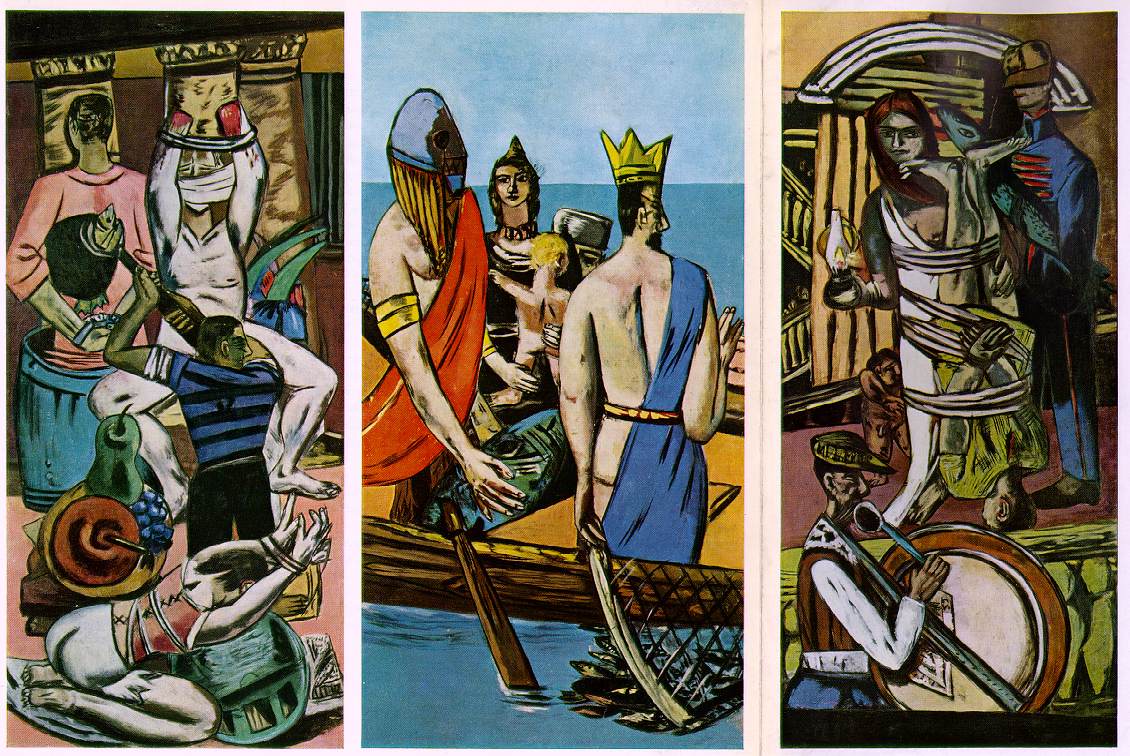
Max Beckmann’s Departure was the culmination of a life’s work, which had been effectively disfigured by politics and the calamitous events of the time.
Unsurprisingly, his approach to art underwent dramatic upheavals as a result of his experiences.
From the moment that he became interested in painting as a young boy, Beckmann (1884-1950) measured himself against the old masters – he was focused on producing academically-correct depictions of sitters and subjects.
That first started to change after his time as a medical orderly volunteer in World War 1. Switching from Impressionism to Expressionism around 1916, the content of his pictures became more cryptic and complex, and his brushwork more slashing and raw.
The perfectly balanced subjects of his paintings began to be distorted in both figure and space. Beckmann’s view of the world, and himself, had transformed, and as a result so did his art.
The imagery, and the intensity of the emotions he portrayed, was layered with symbolism aimed to haunt the viewer.
Although he was creating scathing political critiques of the interwar period, his stylistic transformation was well-received in the Weimar Republic. Beckmann was to find great early success as an artist, a satisfaction that many of his contemporaries never enjoyed in their entire lifetimes.
He even received official honours. In 1925, for instance, he was selected to teach an important masterclass at the Städelschule Academy of Fine Arts. In 1927 he was the recipient of the Honorary Empire Prize for German Art, and the Gold medal of the City of Düsseldorf.
Beckmann’s startling paintings The Bark and Self-Portrait in Tuxedo, found a new, prestigious home when they were acquired by The National Gallery of Berlin.
By 1930, Beckmann had enjoyed a series of major exhibitions, even a retrospective, and been featured in countless publications. He was a much admired figure, whose star had truly risen.
The political triumph of Adolf Hitler was to change everything for him. Once an esteemed cultural figure, Beckmann’s work fell under the category of Modern Art so ardently despised by the Nazi hierarchy.
It was quickly suppressed by the state, alongside Beckmann’s career. In 1933 the Nazi government branded him a ‘cultural Bolshevik’ and dismissed him from his teaching position.
Hundreds of his works were confiscated from German museums, many to be displayed at the infamous Degenerate Art exhibition. The respected artist had now become an example of everything the state considered thoroughly unacceptable.
Today, his magnificent triptychs stand as a summation of his finest work.
Departure is the first, and the greatest, of these. Beckmann denied that it held any specific political content, but given the turmoil of his life, it is hard to see how the work, painted in 1933-35, was not a direct response to Hitler’s Germany.
He began the picture about the same time that he was sacked from his professorship at the Frankfurt Art Academy. This marked the beginning of Beckmann’s thoughts of leaving his country, which he would not do for several more years.
Although it would be possible to see the triptych as having a religious, rather than political meaning, it is revealing that Beckmann thought it best to hide the finished painting in an attic, and labelled the back of the canvas ‘Scenes from Shakespeare’s Tempest’.
Departure contains an elaborate narrative – images of sin and salvation are juxtaposed, and being a triptych, it certainly recalls medieval and Renaissance altarpieces.
The natural inclination is to look for narrative iconography within the painting, but what the viewer finds is deliberately ambiguous. The heavy black outlining, and the three panels to navigate, emphasise the artist’s attempt to distance the picture from the work of the more familiar German realists.
It was felt to be so complex to read, Beckmann’s dealer wrote to him after taking on the painting, and asked how to explain the specific images to visitors who saw it.
In response, Beckmann replied that ‘if this was so essential, he should take the picture away or send it back.’ It is clear however that the work, with its theme of terror and tragedy, is more about social cruelty rather than the atrocities of war.
Many artists of the time used their art as tools to make overt political statements, with the vast majority of them doing so by depicting the casualties and human cost of battle. Beckmann took a different stance, using a vocabulary derived from imagery rooted in classical mythology.
Fortuitously, Beckmann had finally decided to leave Germany, and in 1937 he moved to The Netherlands with his second wife, Quappi. He spent the next decade in self-imposed exile in Amsterdam, failing repeatedly to secure a visa to the United States.
Just as his work had evolved in reaction his involvement in World War 1, once again Beckmann’s art was influenced by the upheaval from his home, and was as powerfully robust.
Beckmann finally managed to reach the United States once the war was over, and during his last three years there he managed to reclaim his status as a respected artist.
He taught at Washington University and earned a professorship at the art school of the Brooklyn Museum, and had his first US retrospective at the City Art Museum in St Louis.
He was, of course, quite different to many of his artist peers. Beckmann was particularly well-read in philosophy and literature, and studied mysticism and theosophy in search of the ‘self’, as he strove to find spiritual dimensions in his subjects.
Despite living in such turbulent times, Beckmann was able to see his work fully appreciated in his life – and this good fortune was illustrated in his death.
Beckmann suffered a fatal heart attack in 1950 on his way to see one of his paintings hanging at the Metropolitan Museum of Art, the pinnacle of artistic achievement.