
Transfiguration of Christ
Giovanni Bellini barely ventured far from his home in Venice since the day he was born in 1430.
Trained by his father, the renowned Jacopo, he was soon creating paintings of such overwhelming power they were to herald the Venetian Renaissance, and rival the pinnacles achieved by the Florentine masters.
Giovanni’s work would attract other artists from across Italy to admire his remarkable skill at rendering colour and light. His strong regard for nature and landscape and his prescient use of perspective and foreshortening were particularly revered.
Bellini’s ability to perfectly capture something as elusive as the beauty of dawn breaking was a revelation to other artists. They were also working with fast-drying tempera, and its pigment and egg yolk base made it exceptionally difficult to manipulate, to blend colour or add depth. Bellini would be the first to express the translucent wonder of natural light using these paints.
But soon Bellini was able to take the splendour of his art to a higher plane – he abandoned tempera for oil paint. A visit from Atonello da Messina introduced him to the versatility of this new medium that was being pioneered in Northern Europe so brilliantly by Jan Van Eyck.
Bellini was transfixed and his art was now to soar, with oils allowing his keen eye to present shimmering life-like images, and add an enhanced atmospheric quality to his work.
He was a deeply pious man and his paintings were central to his religious devotion. He returned time and again to images of the Madonna, and the Passion, bringing a depth of human pathos to the severity and rigidity that were more commonplace in dealing with such subjects.
He was influenced of course by his father and brother-in-law, the brilliant Mantegna, but also by Byzantine art, and its depictions of religious iconography.
Now using oil paints, and enjoying the ability to blend and mix his colours more vibrantly, his pictures were illuminated with far more depth than was possible in his earlier work.
That, alongside his sensual depictions of the surrounding Venetian landscape, both real and imagined, became the hallmark of his emphatic new role. He brought a visual truth to the sense of a city cut off from reality, surrounded by sea.
In effect, Bellini was attempting to shape Venice to be considered alongside Florence, in the vital years that brought us the majesty of the Italian Renaissance.
Clearly, he was also mindful of the extraordinary achievements of Piero della Francesca. Bellini’s wonderful Coronation of the Virgin is thought to have reflected some of the compositional elements favoured by Piero.
Additionally the perspective mastery linking pavement and stone, helping envelop the scene so perfectly, also demonstrates Bellini’s respect for Masaccio, and his definitive views on structure.
But Bellini’s own influence was unparalleled on the great Venetian masters Giorgione and Titian, who would go on to further revolutionise painting. He would also cast a spell over the German artist Albrecht Dürer, who described Bellini as ‘the greatest painter of them all’.
Dürer had been moved by the kindness and support Bellini had given him, even offering the young painter a commission to create a picture for his own collection, a glowing seal of approval.
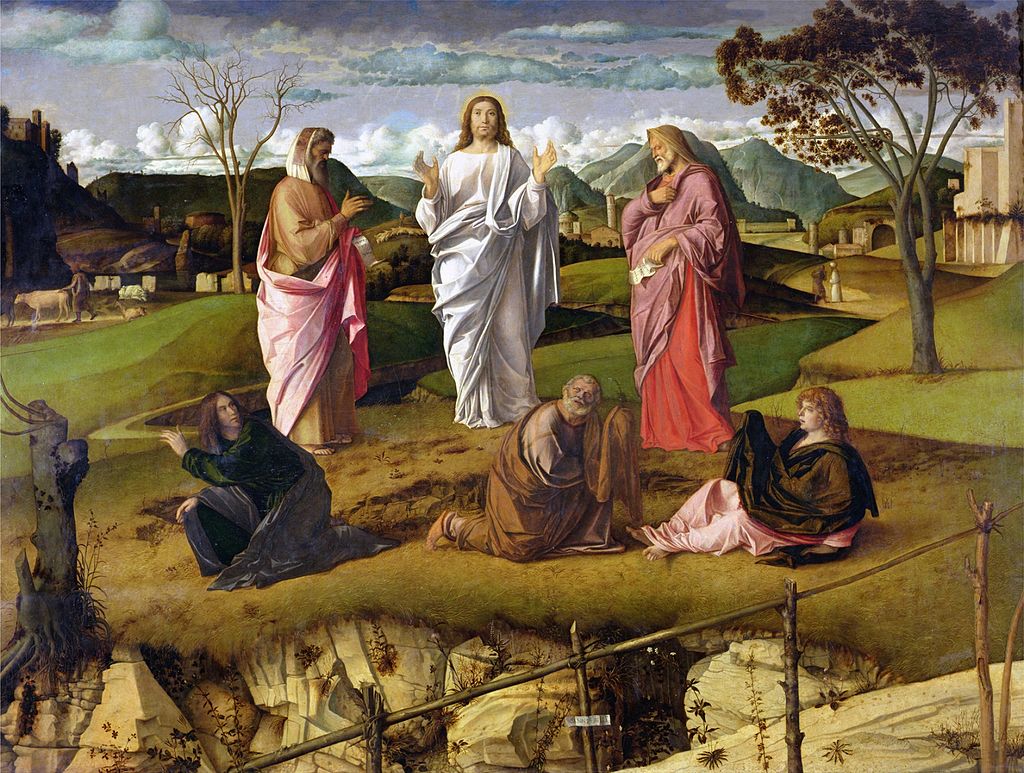
Bellini’s Transfiguration of Christ is a particularly striking example of how his religious works would transcend the more traditional forms of biblical story telling.
Preceding the giants of the 15th and 16th centuries by many decades, he was able to evoke light and shadow with great subtlety. Though the brightness radiates out of Jesus, there is hard light across the centre and the right of the entire scene.
Even the background landscape, paths, meadows and the distant grey hills are all rendered in brightness. However, the slopes on the left appear dark, the tree there appears shrunken and lifeless, sunk into the earth. Opposite, the tree on the right is luxuriant with rich foliage, growing tall into the sky.
Bellini also contrasts a gloomy castle that can be seen in darkness to the left, with the monks and an abbey to the right, placed in an idealised setting. Jesus is pictured as the godly redeemer, casting his light over the world, turning dark into brightness, death into life.
Jesus, Moses and Elijah stand atop the hill in a symmetrical composition, and the picture’s poignantly symbolic grace becomes immediate and profound. Only his abiding piety allowed Bellini to interpret the Transfiguration with such respectful devotion, and sense of glory.
In works such as Dead Christ Supported by the Madonna and Saint John, the tender emotion of this moment has never been bettered. This holds equally true when viewing the large altarpiece from San Giobbe in the Venice Accademia, with the Madonna seen enthroned within a great apse, surrounded by saints that appear rooted in her reflected light in a lustrous symphony.
However, the reverence Bellini enjoyed was not to be always constant.
After his death, critics in the 16th-century reversed the high estimation he had been held in, claiming that he was overshadowed by his pupil Titian.
In later centuries, Bellini was positioned as merely a facilitator of greatness, rather than the genius that he of course was.
Fortunately, in the 19th century, Bellini was championed by the most influential critic of all, John Ruskin, who went so far as to declare his Frari Triptych, and San Zaccaria altarpiece as the two best paintings in the world.
This opened the door to much more detailed analysis of many of his overlooked works, placing Bellini once more in his rightful place – one of the foremost giants who helped forge the incomparable achievements of the Italian High Renaissance.