
The Barbarians
Instead of pursuing art as his father had hoped, in 1909 Max Ernst (1891-1976) enrolled in the University of Bonn to study philosophy. But he was quickly to abandon his course, explaining that he wished to avoid ‘any studies which might degenerate into breadwinning’.
When he finally decided to take up painting, Ernst would become one of the most controversial and innovative artists of his time. His work mocked social conventions, savagely critiquing Western culture, clearly aiming to undermine authority with his pictures.
Probably, this rebellion against authority was also a veiled attack on his father, a strict disciplinarian and amateur painter, who had determinedly insisted that young Max learned the techniques of academic art.
However, disconcertingly for his parent, young Ernst’s lack of any art establishment influence left him unburdened by formal art history training. Instead, he felt free to explore his own methodology, and pursue his own interests.
Increasingly, these developed into a fascination with psychology, as he became obsessed by the art created by the mentally ill. In turn, he attempted to locate the basic core of his own creativity, painting as freely as possible while drawing from his own inner psyche.
His artistic career was brutally interrupted when he was conscripted into the German army, and sent directly to the front trenches. He was fortunate enough to survive, but like so many young men on both sides of the war, he emerged emotionally broken and alienated.
Following the armistice Max returned to Germany, and along with the artist/ poet Jean Arp, helped to form the Dada group in Cologne, whose paramount aim was to be an anarchic force in the art world.
One memorable exhibition they hosted was held in a public lavatory, where visitors were greeted by a sweetly angelic young girl reading graphically obscene poetry.
Also included was a sculpture by Ernst that the public were encouraged to destroy. Unsurprisingly, the whole event scandalised the bourgeoisie who were not amused by such flagrant displays of ‘childishness and obscenity’.
Ernst had also begun to make his first collages, reworking mundane materials, magazine articles and scientific manuals, to create fantastical images. He could now manufacture his own world of dreams, with an emphasis on delving into his own subconscious, and confronting his own trauma, for inspiration.
Drawing on his experiences from childhood, to the horrors he witnessed in battle, he produced absurd, often apocalyptic scenes. Ernst used his found material and combined it powerfully with sourced imagery, such as a chemical bomb being released from a military plane.
The art world had never experienced such furious, yet deliberately banal creations – but sensed that this breakthrough was significant, even of some importance.
Fortunately, Ernst’s urge to be artistically subversive remained with him throughout his career.
In 1922 he moved to Paris, where once again he became a founding member of a new key movement of the 20th-century. Displacing Dadaism, Ernst laid the groundwork for the dominating era of Surrealism, and began exploring autonomism and dreams, using hypnosis and hallucinogens to enhance his process. Surrealists prized the irrational and subconscious over order and reason, and his ground-breaking techniques became quickly respected, as Ernst grew increasingly influential.
One of his most celebrated works, Two Children Are Threatened by a Nightingale, from 1924, was inspired by a feverish dream that Ernst had experienced as a child, when he was struck down with measles.
The boyhood memory that he depicted was ‘provoked by an imitation-mahogany panel opposite his bed, the grooves of the wood raking successively the aspect of an eye, a nose, a bird’s head, a menacing nightingale, a spinning top, and so on.’
Ernst was also acknowledged for inventing the technique of ‘frottage’, involving pencil rubbings of textured surfaces including wood grain, fabric or leaves. The Surrealists instantly welcomed the freedom this method allowed, as the results were both serendipitous and passive – the artist had very little control over them.
Ever inventive, Ernst introduced the technique of ‘decalcomania’ – transferring paint from one surface to another by pressing the two together to create an accidental pattern. He would then incorporate the textures into his drawings and paintings. Alternately, he would scrape wet paint off the canvas surface to achieve a similar pattern. Ernst felt that ‘he came to assist as spectator at the birth of all my works’ simply relying on good fortune if an interesting result could be achieved.
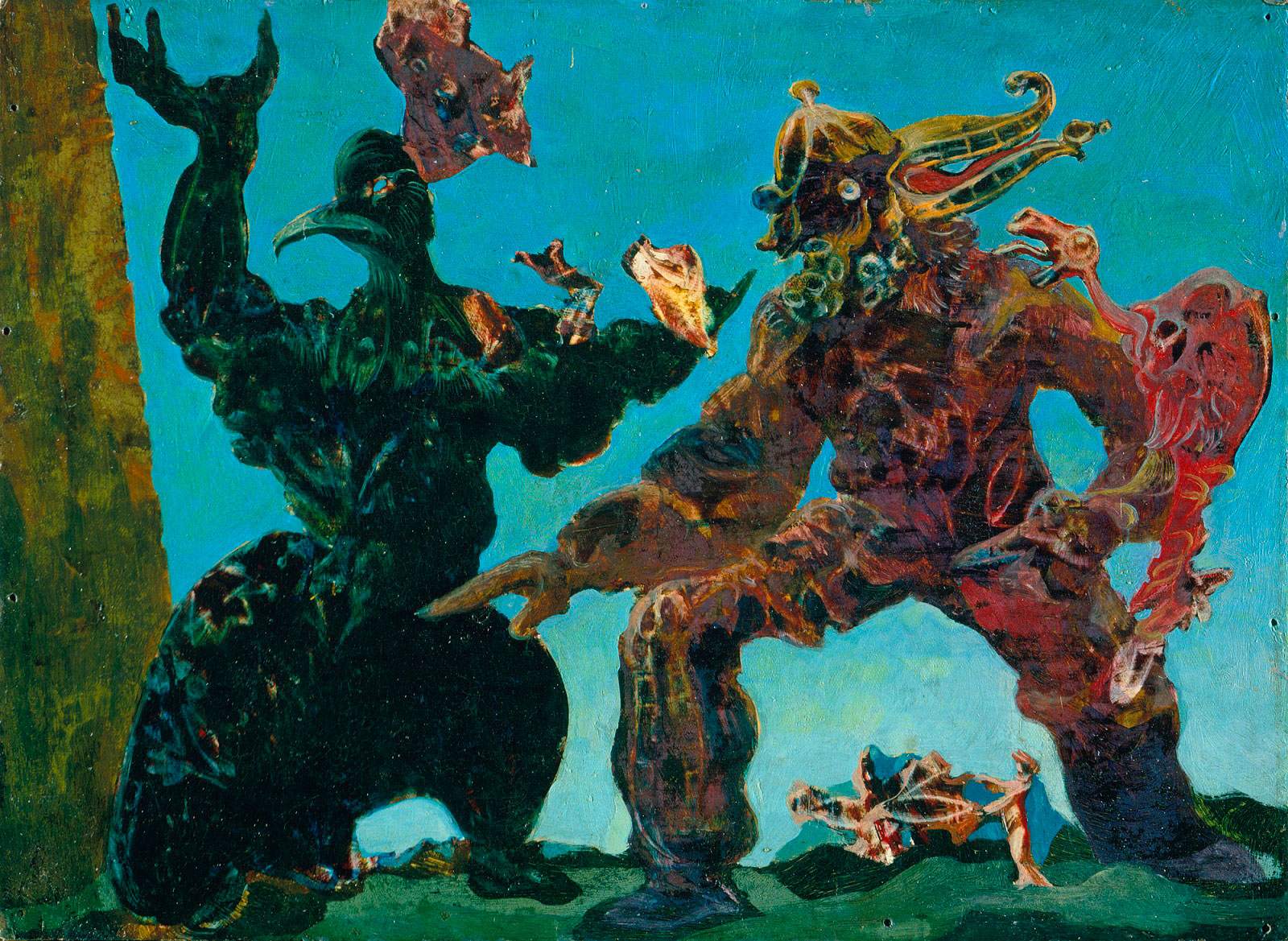
Ernst’s working methods can be seen finally achieving perfect harmony in his masterwork from 1937, The Barbarians. This remarkable picture, heavywith Freudian theories, personal mythology and childhood memories, transforms democracy into barbarism – ‘barbarians always believe that they are keeping the heavens from collapsing and that the gods need their help’. In the painting the central woman-bird creature gestures with her right hand as if she is keeping the dome of the sky in her palm.
The man-octopus appears to be preparing to launch a military advance, in order to conquer human life, culture, traditions and all that mankind has created.
According to Ernst, ‘barbarians are a combination of under-life and super-life, children of Hell and Paradise – a monstrous blend of the two.The male’s aim is to destroy the middle-ground of human life, while the female brings paradise to earth by creating apocalyptic hell.’
The tiny humans at their feet are worshiping the barbarians out of fear, a sentiment strongly echoing the events prior to both World Wars, which contemporary viewers would have been only too aware of.
There were many artists who were caught up in the horrors of World Wars 1 or 2, but few whose art was so directly informed by their experiences as Max Ernst’s. He was, after all, categorised as an ‘enemy alien’ while living in France, while Americans saw him in the same light when he arrived there as a refugee. But in truth, although Ernst played an exceptionally crucial role in 20th-century art, he remains more recognised by art historians and academics than the general public.