
Carcass Of Beef
In 1912 Chaim Soutine enrolled at École des Beaux Arts in Paris. The 19 year old was forever in the Louvre, carefully studying the work of Goya, El Greco, Ingres and Courbet.
But it was the paintings of Rembrandt that the young Russian was particularly awestruck by. The impact of his portraits and still-lifes with their dramatic use of light transfixed him, and he would regularly take the train to Amsterdam to see more of his outstanding works.
Young Soutine would sleep on park benches outside of the Rijksmuseum simply to spend more time with the institution’s Rembrandt collection.
In Paris, he lived and worked in ‘The Beehive’ – a run-down artists’ studio and apartment building on the outskirts of the city.
Soon, he would be taken under the wing of the much-admired Modigliani, who helped Soutine overcome his shyness, and ease his intense and temperamental manner – they were hurdles to socialising in the art world and advancing his career.
Modigliani had been struck by the young artist’s skills and introduced him to his art dealer, who promptly offered to represent him.
He was to be a virtually lone Expressionist at a time when Paris was filled with Cubists, Dadaists and Futurists.
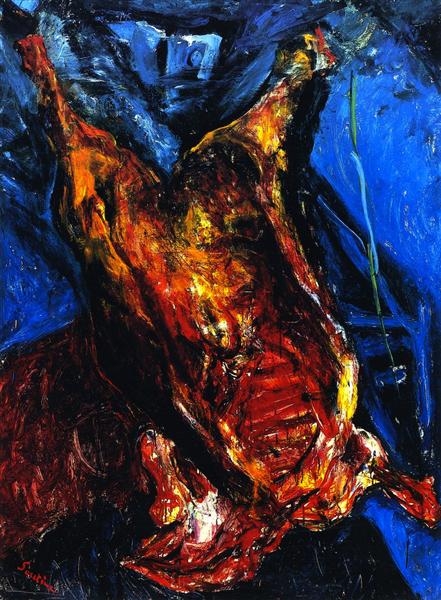
Although Soutine’s paintings contain clear references to the works of the masters he so revered, he reinterpreted their approach with a heightened tension and drama. Using very thickly layered oils, his animal carcass paintings brought him immediate attention, though not always positive.
Filling his canvas with a hanging side of beef, he pictures it sliced open, as if it were baring its soul to the viewer. It was the role of his studio assistant to bring a bucket of fresh cows’ blood from the local butcher every few days, and pour the contents over the dangling carcass to maintain its sharp colour.
His pupil would have to fan away the flies as Soutine painted, and deal with the complaints of neighbours about the foul smell. He also had to calm the health inspectors who were threatening to haul the beef away.
They agreed to let it remain, provided it was injected with ammonia deodorant and the studio was regularly fumigated.
Soutine’s dynamic use of heavy layers of paint, in as many as 40 different vibrant hues, emphasised the glistening putrescence of his hung carcasses and poultry.
Modigliani firmly believed in his young protégé but few others agreed, and Soutine’s work remained unsold. But overnight this was to change.
Legendary American collector Albert Barnes arrived in Paris in 1922, looking for works to add to the breathtaking collection housed at his art foundation in Pennsylvania. It was filled with some of the greatest works by Picasso, Cézanne, Matisse and Renoir, but Barnes was yet to discover an unknown artist to join such illustrious company.
He noticed Soutine’s portrait of a pastry chef in a gallery, and wanted to see more. He was taken to the artist’s dealer, and bought every one of Soutine’s pictures he was shown.
The news of Barnes’ purchases spread quickly around the Parisian art community, and suddenly Soutine found that he was now a celebrated painter. Soon, other collectors were buying his pictures, and the frenzied, agitated approach he took to his work became the talk of other artists.
‘Soutine painted rapidly’ recalled his sculptor friend Chana Orloff, ‘nurturing his ideas for months and then, when ready, he started the painting in fury. He worked in a feverish trance, and once finished, he was weak and depressed.’
Another friend noted that Soutine himself remained ambivalent towards his own work, quoting him saying ‘All you see here is not worth anything. It is rubbish, even if it’s better than the work of Chagall…someday I’m going to murder my paintings, though these are too contemptible even for that’.
True to his word, he would routinely slash canvases to shreds. Others, he would simply burn. His dealer would often remove pictures from Soutine’s studio to save them from being destroyed. The artists was even known to buy back some of his own paintings, simply in order to rid the world of them.
Often morose about his work, he would not touch paints for months at a time. A hint of inner despair can be seen in his eviscerating self-portrait, Grotesque, now seen at the Musée d’Art Modérne in Paris.
Perhaps no painter, not even Rembrandt, examined himself with such dispassionate cruelty. Soutine may not have been a handsome man but the unappealing figure seen in the picture, with deep-set anguished eyes, a distorted ear, a humped shoulder, and a misshapen arm, made the disenchantment with which he viewed of himself abundantly clear. ‘Pitiless, ruthless work, ridden with self-contempt’ is how a notable critic described it.
The painting that first caught Barnes’ eye, The Little Pastry Chef is also somewhat unflattering of its subject, with the angular features of the young man twisted into a sad, deadened gaze. But the painting itself is a wonder – the bright red handkerchief the boy clutches contrasts radiantly with his white chef’s uniform, and his forlorn loneliness. Perhaps Soutine saw himself in the unhappy-looking young man.
Carcass of Beef was clearly a homage of sorts to Rembrandt’s Slaughtered Ox that Soutine was so deeply struck by in the Louvre. However, unlike Rembrandt, Soutine isolated the subject centre-stage, creating a more darkly visceral image filled with emotional turmoil, and thick with deep layers of colour.
Today, his manipulation of paint seems a precursor to the later Abstract Expressionists that came to the forefront of American art in the post-war decade. It is certainly reflected in the all-over compositions and gestural brushwork of Jackson Pollock and Willem de Kooning, both of whom shared a fascination with Soutine’s paintings. His suspended meat still-lifes were also to be the direct source of Francis Bacon’s pictures of hanging carcasses.
Although Soutine clearly experienced success in his lifetime, he seemed to take little comfort in the admiration of others, and perhaps would not be troubled too deeply about his own legacy.
Nonetheless, many dedicated painters stand and gaze at his pictures for hours on end in museums – much like he did as a student, staring intently at the work of his heroes.