
Rain, Steam and Speed
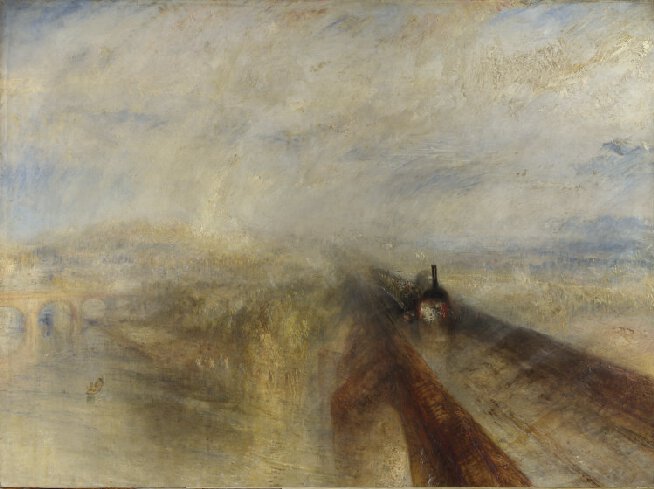
The 19th century brought railways criss-crossing the British countryside, a new way of connecting cities and people to each other.
It changed not only the landscape but also became the most potent symbol of escalating industrialisation.
Through Turner’s (1775-1851) use of high contrasts, strong diagonals and unrestrained paint handling, the abstractions of Rain,
Steam, and Speed caught a sense of the rapidly advancing industrial leaps of that era.
Turner evoked the speed of the early morning train hammering through the pounding rain, as it crossed the Maidenhead Bridge over the River Thames.
Up until this point, people had either walked or had ridden a horse. If you could afford it, you could take a carriage with multiple horses and go a little faster.
But now, people were being transported mechanically for the first time.
The train must have appeared a magnificent, roaring beast.
On the extreme left of Turner’s painting is an old stone bridge and on the right stands its modern brick replacement carrying the railway as it cuts across the canvas.
A farmer is seen ploughing steadily to the right, highlighting the confrontation between technological power and nature, further emphasised by the train steaming towards a small rabbit in the lower right hand corner, hopping away as swiftly as possible.
The picture not only portrays the rise of industrialisation – it equally explores the complex and subtle relationship between man and nature.
Turner’s ability to handle tone and form abstractly was entirely revolutionary.
Despite the dramatic impact of the painting, the railway had not, until then, evoked any attention from leading artists during the first two decades of its existence.
A lady who had boarded the same train as Turner at Exeter in 1844 explained, ‘the weather was very wild and a violent storm blotted out the sunshine and blue sky… the gentleman seemed strangely excited, opened the window, craning his neck out and finally calling out to come and observe a curious effect of the light.’
He had captured the scene mentally but much of the painting is fictional in specific terms, and seems intent on recreating the sense of atmosphere.
The one object that comes through with clarity is the black iron of the train’s chimney, with the engine and carriages dissolving into the paint.
Obviously, the work attracted much negative criticism as it challenged the aesthetics of traditional landscape painting.
However, William Thackeray was awed by the energy of the locomotive, and described how he felt that at any given moment ‘it could dash out of the picture’.
His published review about this painting in 1844, when it was exhibited at the Royal Academy stated: ‘As for Mr Turner, he has out-prodigied all former prodigies… the world has never seen anything like this picture.’
He was describing what would later form the crux of
Impressionism.
During his adult years, his fellow artists claimed that he was interested in nothing but his drawings and paintings, the improvement of his art, and travelling to find ideal locations to go sketching.
His perceived self-centredness, and fixation with his work led him to be disliked socially. The topographical artist Edward Dayes published his view on Turner, stating: ‘The man must be loved for his works; for his person is not striking nor his conversation brilliant.’
In another instance, Sir Francis Bourgeois, a fellow member of the Academy called him ‘a little reptile’, to which Turner promptly replied that he was ‘a great reptile – with ill manners’.
He had gained entry into the Royal Academy at fourteen, where painting was not initially taught.
Students only learned to draw from plaster casts of antique statues. He made the move to painting two and a half years later, and at seventeen was awarded the ‘Greater Silver Palette’ award, boosting the sale of his artworks.
On finally becoming an Academician, he gained access to an exclusive club which gave him the benefits of displaying his works publicly each year, without the irksome need to submit them for approval by a selection committee.
The Royal Academy had great influence, and its annual exhibition was the culmination of a year’s work by its members, and held much sway.
During the hanging of the Royal Academy exhibition in
1831, Turner and artist John Constable came into conflict.
Both extremely competitive, they regularly schemed against each other, often descending into pettiness and childish insults.
Constable was overjoyed when Turner, ‘the genius’, had an unsuccessful exhibition.
The art critic from The Times compared Turner’s work to ‘soapsuds and whitewash’, while another titled them ‘pictures of nothing’.
There was much sniggering at a pantomime skit in which a baker’s boy dropped a tray of yellow and red jam tarts on the floor, quickly put a frame around the mess, and sold it off as a Turner for £1,000.
Constable bitterly quoted that Turner’s technique was ‘extravagant and inattentive to detail’.
During the 1830s, Turner mostly submitted unfinished paintings to the annual Royal Academy exhibition, which he then hurriedly completed in the galleries after they were hung, during the time actually designated for varnishing.
Crowds would gather to see him at work. On one celebrated occasion, Turner strikingly painted a patch of red lead on his grey blue painting of the sea, in contrast to Constable’s bright hues of vermillion hanging next to it.
The next day he turned the bright red patch into a buoy, completing a remarkable picture, and a rather crestfallen
Constable was forced to declare that, ‘Turner has been here and fired a gun.’
He was reviled by Queen Victoria for his increasingly abstract works, but nonetheless chose to bequeath hundreds of his greatest works to the British nation, on a government agreement to house and display them in a designated museum – a promise reneged upon. Indisputably, he was the last of the Old Masters – and the first and most inspiring of the Modern Masters to follow.