
Country Doctor, 1948
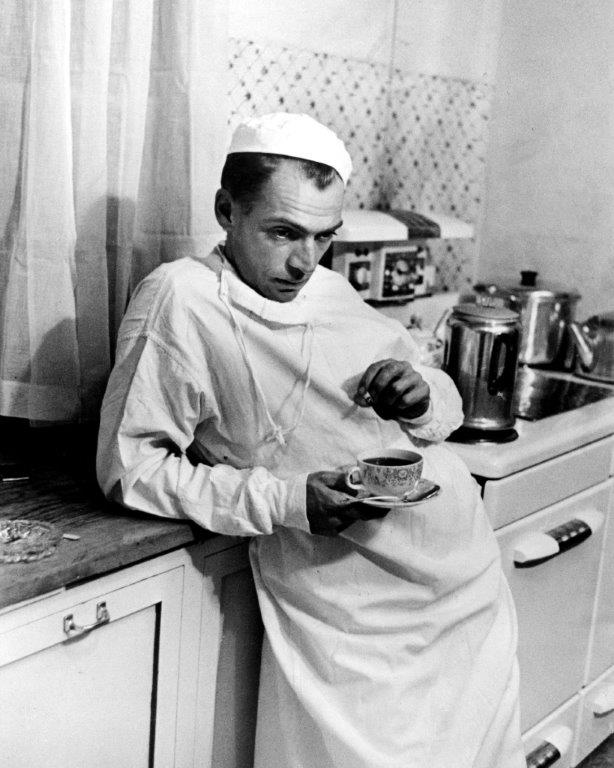
When Life Magazine published a series of pictures on the life of a country doctor in 1948, it caused a seismic shift in perceptions about photo journalism.
W. Eugene Smith had spent over three weeks shadowing a Colorado general practitioner to produce his picture essay. It drew widespread attention, and was seized upon aesthetically as a radical new artistic direction.
The life of a hard-working, rural physician was seen in this intimate study of a humble man who quietly dedicated his life to helping others – often requiring long hours into the night as seen here. The poignant, uncompromising narrative created by these images touched many Americans, and soon altered the ambitions of professional photographers who followed Smith’s pioneering example.
Smith was later to produce more ground-breaking photographic reports, one of which, ‘Man of Mercy’, 1954 opened the eyes of the world to the work of Dr Albert Schweizer as he tended the leper colonies in Africa.
Even in the 1970s Smith was still emphatically tackling the most demanding of subjects, documenting the terrible effects of mercury pollution on the inhabitants of a Japanese fishing village of Minamata. The photographic evidence was unwelcome by the chemical company responsible for the poisonous waste disposal, and he was badly beaten by thugs employed by the firm. Smith almost lost his eyesight as a result of the attack.
The camera was undoubtedly his enduring, life-long passion. He began taking photographs for his local newspapers straight after graduating from high school, moving to New York to work on the staff of Newsweek. He also secured freelance commissions from other leading publications including Collier’s, Harper’s Bazaar and The New York Times.
Smith became highly-regarded for his work and his incessant perfectionism, but his thorny personality made him difficult to work with. He was fired from Newsweek for refusing to abandon his 35mm Contax camera for a larger format.
This led him to the doors of Life magazine, where he was assigned to cover the front lines of the Pacific combat zones during the US war offensive against Japan. Sadly, landing the prized position at Life was not as fortunate as it may have seemed – he was severely wounded by a grenade in Okinawa in 1945, and it required two years for him to recuperate.
He underwent 32 operations, and it wasn’t until 1947 after a painful convalescence that he was able to pick up his camera again. He explained that, ‘The day I again tried for the first time to make a photograph, I could barely load the roll of film into the camera. Yet I was determined that the first image would be a contrast to the war photographs, and that it would speak to an affirmation of life.’
This photo was titled ‘The Walk to Paradise Garden’, picturing his own two children entering a forest clearing. It was to become one of his most celebrated pictures, and was a centerpiece of the seminal photographic exhibition ‘The Family of Man,’ at the Museum of Modern Art in New York in 1955.
Clearly his experience of being at the heart of a ferocious conflict left an indelible mark. He pointed out that that alongside his battle pictures covering grim news events, they set him on his path to produce the most socially-conscious body of work of any of his contemporaries.
Following the brilliant ‘Country Doctor’ series, he decided to examine life in an impoverished part of Spain. Moving to live in a struggling village over a period of months, he saw at first hand the desperation of locals attempting to rely for sustenance on their exhausted soil. ‘Spanish Village’ from 1951, resulted in some of his most moving, heartfelt prints. Immersing himself to such a degree with his subjects was unheard of in photography.
However, his relationship with Life magazine was always a turbulent one, and despite the accolades that both he and the magazine received for his photo essays, he never seemed at ease.
Smith’s high sense of humanitarian purpose was at odds with a mass-appeal magazine like Life, who were trying to embrace the optimism of the mid 1950s in the US. He resigned, and had to pursue freelance work, joining the Magnum agency that represented many leading photographers.
They were able to support him and enabled him to secure grants. In 1956 he began an ambitious photo-essay on the city of Pittsburgh, an industrial city beleaguered in social upheaval. He moved there and obsessively took over 11,000 photographs detailing its decline and the effect this was having on residents.
Sadly, Smith never recovered from the sense of trauma he felt recording their plight; the pictures were never published, and he was mentally and financially broken. He could only turn to a teaching post in Arizona, while trying to pull together his archives. He suffered a fatal stroke in 1978, aged 60.
He was inducted into the International Photography Hall of Fame in 1984, and he was described as ‘being famous at twenty and a legend at forty’. More revealingly in Smith’s own words, ‘I am always torn between the attitude of the journalist, who is a recorder of facts, and the artist, who is often necessarily at odds with the facts. My principle concern is for honesty, and above all honesty with myself.’