
Saddle, 1976
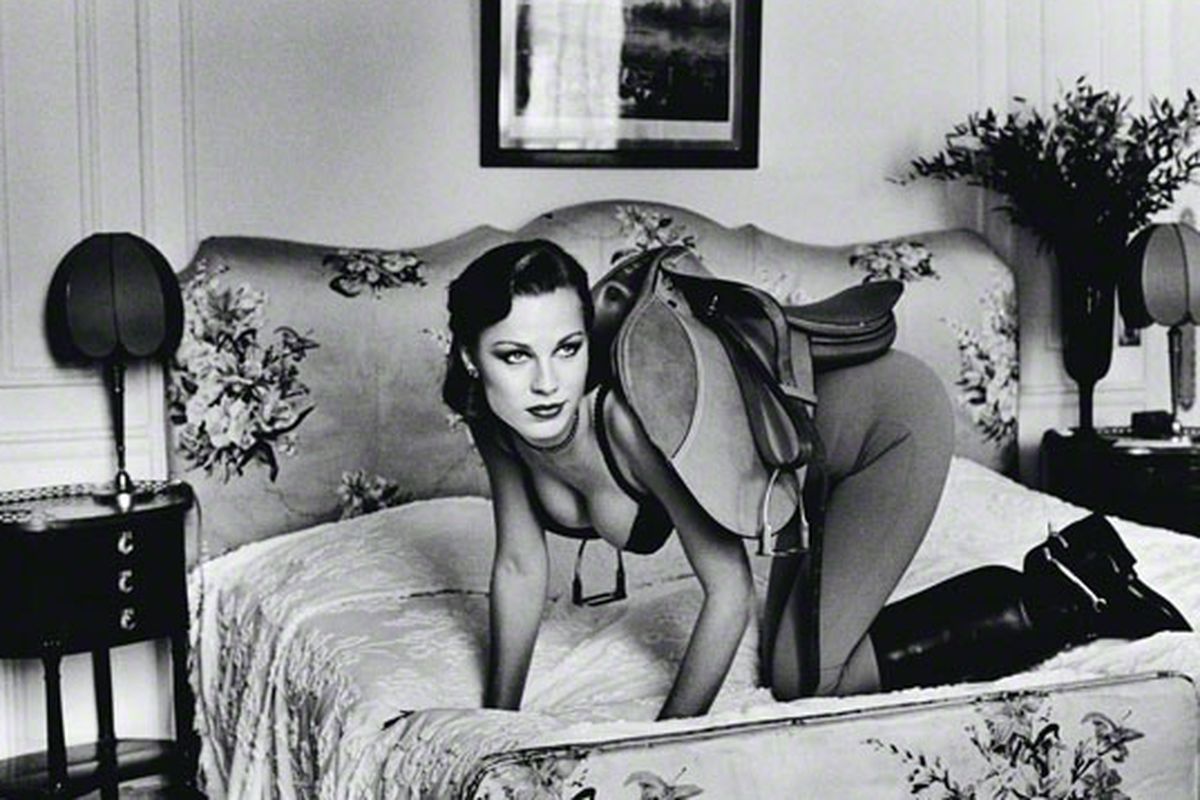
Helmut Newton was revered, and reviled, in equal measure, throughout his career. Although he never played by conventional rules, he was routinely accused of taking fashion pictures to the edge of pornography. But even having exhibitions of his photographs spattered in paint by protestors did little to diminish his reputation amongst a legion of admirers.
Women certainly played a central role in his work, and though there was noisy criticism of how he portrayed them, Newton (1920-2004) insisted that he was always a feminist, declaring: “I’m against this ghetto that women are put in, often by themselves, ‘women photographers’, ‘women artists’; what counts is the work.”
Unarguably, his images are a matter of taste, given how fetishistic and extreme some of them are. Even late in life he was capable of shocking his audience. His 1994 photograph for French Vogue pictured a model’s hand dripping in Bulgari diamonds – as it dismembered a chicken. It enraged the jewellery house so deeply, they threatened to withdraw all future advertising from the magazine.
He certainly offended sensibilities in the fashion world, as well as art critics and the public, with his development of “porno-chic”. Quite often in his more scandalous images women wore little more than a pair of high-heels and suspenders. But supporters argued that the photographs were a genuine exploration of power, sexuality and gender roles, topics that Newton loved to challenge.
His pictures turned the socially accepted norms around, and although his subjects were naked, they were often presented as powerfully Amazonian, firmly returning the viewer’s gaze. Of course to many observers this was faintly redolent of dominatrix allusions.
Ever since he was hired by French Vogue in the 1950s, Newton hypersexualised imagery courted controversy, but his striking compositions elevated his career and placed him centre stage. The picture seen here caused particular uproar, but also made him a household name in the photographic world.
While it infuriated many women, Newton maintains that it was meant as a playful subversion, explaining that: “You see so many images of women riding men”, which seems to explain little other than to present an insight into Newton’s magazine-reading choices. In fact, the photograph was shot for the male publication Adam, but was also reproduced by Vogue at the time.
The work clearly defines how Newton was able to bring taboo subjects of fetishism and sadomasochism into mainstream fashion and photography. Newton, it must be agreed even by his detractors, was fearless, and able to withstand high levels of abuse and vilification. He never swerved from his belief in the importance of his art, and the subject matter he wanted to highlight.
This begs the question of whether Newton’s work would be published in any mainstream magazine today, when sensitivities to the deliberately provocative nature of his photographs are now sharply heightened.
Born in 1920 in Berlin, the city left its mark on the photographer for years to come. He began taking photographs at the age of 12 with a Box Brownie. His mother would often take him to tea dances at grand hotels, which were to soon become his main source of inspiration. He would take pictures of the glamorous ladies, much a like an early society photographer.
Ironically, in 1936 he later went on to apprentice with Yva, a photographer who did in fact specialise in recording glittery parties. Two years later his Jewish parents fled with him from Germany to escape the imminent threat to their safety. While his parents hurried to South America, young Helmut chose Singapore, where he worked very briefly as a news photographer. Unfortunately, by his own admission he was “thrown out after two weeks because I was no bloody good.”
He moved on to Australia where he served in the army as a truck driver, and then worked as a fashion photographer in Melbourne. He married Jane Browne in 1948, and they remained together as an inseparable couple throughout his life; she was a highly-regarded photographer herself, using the pseudonym Alice Springs.
His reputation was growing and his fashion and theatrical work brought him commissions from British Vogue. A heart attack in 1970 curtailed Newton’s output, but his wife encouraged him to continue to work within his studio, where he was to produce his ‘Domestic Nudes’series, seen as the pinnacle of his erotic-urban style.
He explained that he felt his breakthrough came ‘when I was so ill there was a good chance of dying. I promised myself that if I survived I would never again pander to a magazine’s requests, or follow the idea of an art director. I would take images that are personal.’
Fortunately, his ‘personal’ perspective was more vivacious, dynamic and deeply sensual than could have been achieved from an art director’s brief. He simply redefined what fashion photography could accomplish.
As an example, he pictured two beautiful fully-clothed women standing at the side of a swimming pool, surrounded by striking male models in skimpy briefs – who were busy admiring their own physiques, in a stark reversal of gender stereotyping.
In 2004 he was involved in a fatal car crash on Sunset Boulevard in Los Angeles. His ashes were buried in Berlin, and the city now has a museum dedicated to Newton’s greatest photographs. His legacy is a simple one. ‘Newtonian’ is an adjective now commonly used in artistic circles to indicate a proud and provocative celebration of the female form.