
Dovima with Elephants, Evening Dress by Dior, Cirque d’Hiver, Paris 1955
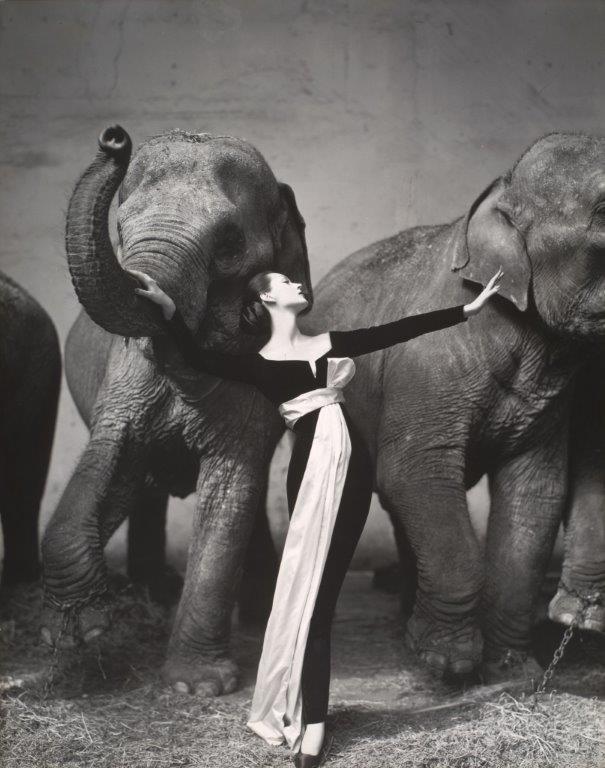
This image by Richard Avedon (1923-2004) is almost certainly the greatest fashion photograph that has ever been taken.
However, Avedon was renowned as a self-critical perfectionist, and even said of this tumultuous work “I look at that picture to this day, and I don’t know why I didn’t have the sash blowing out to the left to complete the line of the picture. The picture will always be a failure to me because that sash isn’t out there.”
A leading model during the fifties, Dovima (Dorothy Juba) is seen in all her alabaster elegance besides the wrinkled grey of the elephants’ dark hide. The upright, angular pose that she strikes contrasts dramatically with the rough, weighty presence of the elephants, as she strokes one and reaches for the other.
The massive beasts seem enchanted and tamed by their slender mistress, the beauty in this re-interpretation of the fable.
This photograph also introduces the genius of nineteen-year-old Yves Saint Laurent, whose design for Dovima’s dress was his first creation for Dior.
Avedon was held in tremendous regard by his contemporaries throughout his 20 year collaboration with Harper’s Bazaar magazine, after dramatically doing away with the robotic, mannequin portrayals of fashion models. Instead, he enlivened them with vigour and personality, not shying away from what would conventionally be seen as their human side, ‘flaws’ and all.
But it was to be his startling, large-scale visceral portraits of the greatly celebrated, or the completely unknown, that elevated him to totemic status – a pioneer in the influential breadth and creativity of his work.
His photographs, claimed the New York Times, have “helped define America’s image of style, beauty and culture since the 1950s”.
There was no place to hide in his portraiture, providing intense detail in his extreme close ups, often taken to the edge of the frame and cropped tight. They were routinely set against a blank white background to heighten the sense of clinical intimacy, to the point of being unsettling and occasionally disturbing, as though the viewer’s scrutiny is intruding. Less flattering, with less distraction, and unremittingly truthful.
One of the most revealing of these works was his picture ‘Dorian Leigh, Evening Dress by Piguet, Helena Rubinstein apartment, Ile Saint-Louis, Paris, August 1949’. He has captured the model in full-length profile prior to a shoot, standing leaning into a mirror, in deep concentration as she inspects herself. Fully absorbed in her powder room, she is clearly unaware that she is being observed as she prepares herself, seen in an ungainly position as she bends towards her reflection to get a closer look.
Was this a fashion photo? Or a work of art reminiscent of the intimate backstage ballerina pastels of Degas? Clearly it was both. He found beautiful women more striking when they weren’t making any effort to be glamorous, just idly smoking, or drinking, or in this case, just checking herself out in a mirror.
He started his career in a fairly mundane way, taking official identification snaps of his fellow sailors while serving in the merchant marines; his interest in fashion photography had been kindled after landing a job as an assistant toHarper’s Bazaar’s acclaimed art director Alexey Brodovitch. As Avedon’s skills became apparent, he was hired by the magazine to cover the spring collections in Paris.
Instead of shooting the haute couture runway shows, Avedon placed his models in Parisian cafes, streetcars and bars. Of course, he was to make photographic history when he took a model to the circus, in the extraordinary picture seen here.
Soon, he was offered portrait commissions, and was able to capture the vulnerability in larger-than-life figures like President Eisenhower, Bob Dylan, Marilyn Monroe, The Beatles, Dr Martin Luther King, and Malcolm X. He would also create explicitly political images of demonstrators protesting against segregation, and the Vietnam war, as well as picturing veterans from the conflict, and napalm victims.
After he moved to Vogue in 1966 he went even further to push the boundaries of fashion work, with surreal, provocative imagery of violence. His final role was as the first staff photographer in the history of New Yorker magazine. As he put it: ‘What I happen to do is photograph people of accomplishment, not celebrity, and help define the difference once again’.
He was aware of the new mantle as a social force that his politically relevant new role had thrust upon him. Touchingly he wrote ‘Sometimes I think all my pictures are just pictures of me. My concern is the human predicament. But what I consider the human predicament may simply be my own’.
It is revealing that for the last years of his father’s life, he was driven to chronicle the steady deterioration of his parent’s health, slowly dying as cancer ravaged his body.
He spent six years regularly travelling to Florida to photograph these bleak images. Far from idealising, Avedon explained how influenced he was by the painter Egon Schiele, whose work he felt had ‘contained a level of candour and complexity that was far removed from the tradition of flattery that lies in portrait making’.
His father is seen growing increasingly gaunt and distressed, standing sombre and anxious in a black suit against a pure white background. Seldom, since Goya, has the truth of mortality been captured so starkly.