
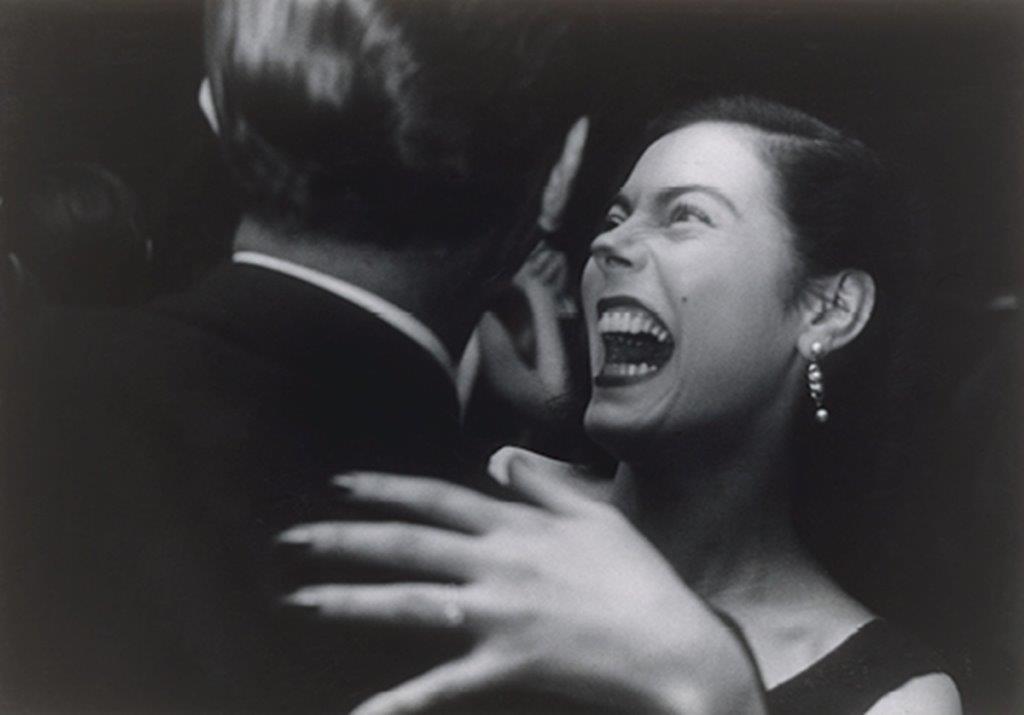
El Morocco, New York, 1955
Garry Winogrand may have been a documentary photographer, but he had an approach that was unlike any of his high-achieving peers, Diane Arbus, Robert Frank and Lee Friedlander.
While many street photographers stalked the sidewalks of major cities doing their best to remain invisible, capturing urban life at its most real and raw, Winogrand was unconcerned about being noticed.
Instead it seems as though he clicked the camera shutter at the very moment that his subjects registered his presence. This approach created a deeper sense of intimacy, and sometimes awkwardness, leaving the viewer with a desire to know what happened next.
A telling example was his picture capturing an adolescent girl staring at him as if she has just noticed that he is there – while alongside her another older girl is seen looking at his lens out of the far corner of her eye as she is kissed by a young man.
His snapshot approach seemed to others to demonstrate his lack of patience and restlessness, but in fact it was the result of Winogrand’s obsession to photograph almost manically. He left behind about 7000 rolls of unprocessed film after his death, clearly preferring to use every moment taking pictures, rather than concern himself with any of the other elements of photography. Curator Leo Rubinfien describes how Winogrand “often worked in a headlong way, preferring to spend another day shooting rather than processing his film or editing his pictures”.
The energy and vision of his photography is wide-ranging, but in the majority of his most acclaimed works, the people caught in Winogrand’s pictures appear to just have seen him, even taking in his camera lens with coldly suspicious eyes.
He certainly didn’t specialise in a single type of subject, and during his career he photographed business moguls, famous actors, athletes, hippies, politicians, soldiers, car culture, demonstrators, construction workers, and well as the many people he spotted on the streets that caught his interest.
It appeared to some professional observers that he lacked ambition in notions of composition, or that he seemed unconcerned by aesthetic values. Winogrand was simply more beguiled by undiluted information. In almost all his photographs there is an abundance of detail, but at the same time there seems to be even more that is withheld.
In the photograph seen here, Winogrand shows a close-up of a couple dancing at El Morocco – one of New York’s most fashionable nightclubs in the 1950s. It was the perfect backdrop for him to demonstrate his skills, working for Harper’s Bazaar, Colliers, and Pageant magazines. Winogrand routinely focused on the dancers’ response to the music and the atmosphere of unfettered fun, ideal for his candid approach.
What makes his picture so compelling is the choice of this particular moment to shoot. It is clearly not a particularly flattering picture of the main protagonist, who appears somewhat delirious. Its claustrophobic atmosphere is due to the close cropping, and the focus on the woman’s claw-like hand on her partner’s shoulder. The fact that his expression is hidden only adds to the frenetic tone of the image.
This directly invasive, and yet intuitive style made him one of the pre-eminent urban photographers of the day. At the time he took the picture, there was a sense of optimism in America – the war was well over and the economic depression was giving way to prosperity once again. Magazines were really only interested in showing the pleasanter side of life, and this photograph was a thoughtful balance of post-war enthusiasm, and the wilful determination of the media to airbrush away the ills of society.
Born in the Bronx in 1928, to Hungarian and Polish immigrants, Garry led a relatively unremarkable childhood in a predominantly working-class section of New York. After graduating high school he attended a photojournalism course, and his aptitude quickly became clear, helping him pick up a variety of freelance work. The high regard for his work brought him ever more prestigious assignments
Over the course of his career he was to be awarded the Guggenheim Fellowship three times. The first allowed him to travel widely, and photograph without the commercial pressures of a specific assignment.
During his second fellowship, he decided to explore ‘the effects of the media on events’. He produced over 6,000 pictures over 7 years, images taken at organised functions; this series was so widely admired it led to an exhibition at New York’s Museum of Modern Art, and a book titled ‘Public Relations’.
An important achievement was the 1975 publication of a book, ‘Women are Beautiful’, a retrospective compilation of his greatest photographs in which he had managed to capture his female subjects, just as they noticed him. Whether caught laughing as they spotted him, or glaring at the camera in defiance, or simply staring straight through him, Winogrand was utterly in thrall of every variety of womanhood.
His great success, and the high admiration in which he was regarded by his peers, was to be short-lived. When he was 56 was diagnosed with cancer of the gall bladder that quickly proved fatal.
Winogrand is sometimes remembered as having taken many photos which seemed obtuse to a number of critics at the time; he still remains difficult for some to sharply pinpoint today. But undeniably, he managed to alter the grammar of photography, and was a pioneering influence on the grittiness that was to come.