
Gun 1, New York, 1955
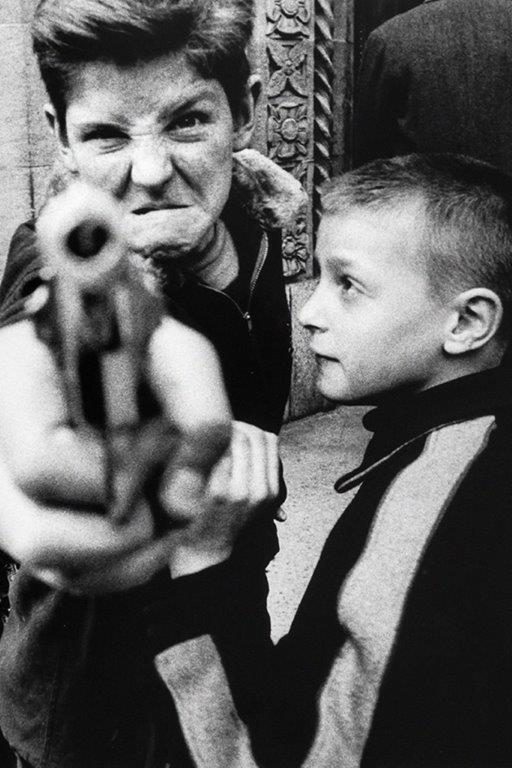
‘I approached New York like a fake anthropologist, treating New Yorkers like Zulus.’ William Klein offered this explanation for the photographic diary he created about his birthplace.
The works were not greatly welcomed by viewers, who were unnerved by the visceral, grittily-aggressive portrait of the city he presented. They were to be rejected by magazines as being too chaotic, depressing and grungy, almost un-American.
But when a book was published of his New York pictures, it resounded around the art and photography world like a thunderclap.
As he put it “My aesthetic was the New York Daily News. I saw the book I wanted to do as a tabloid gone berserk, gross, grainy, over-inked, with a brutal layout, bull-horn headlines. This is what New York deserved and would get.”
Trained in Paris as a painter under the wing of Fernand Léger, he found early success with exhibitions of his work. Nevertheless, he soon abandoned his paintbrushes for a camera, and was to quickly achieve widespread acclaim working as a photographer for Vogue in Paris.
His pictures were considered extraordinary, even revolutionary, for their ironic, somewhat ambivalent, approach to the world of fashion. Models were pictured wearing their haute couture fashions in grimy urban environments, looking strangely threatening. He would routinely use extra high-grain film in his fashion shoots which he over-exposed, stretched and distorted.
With his new vision of mixing the beautiful and the grotesque in panoramic wide-angled shots, his pioneering style was considered truly remarkable, even irreverent. Clearly, Klein uncompromisingly rejected the traditional prevailing constricts of fashion photography.
Much as he stood fashion photography on its head, he distanced himself from the prevailing values of street photography set by masters such as Henri Cartier-Bresson and Brassaï.
He couldn’t accept that the photographer should remain unseen and unnoticed in the search for interesting glimpses of street life as it naturally unfolded. Klein took a far more radical approach. Rather than voyeurism, he developed a new language using wide-angled telephoto lenses, imbalance, and motion blur to produce a discord that gave his images a sense of immediacy.
They seemingly thrust the viewer into the centre of the scene. As Klein said, ‘I had no respect for good technique because I was self-taught, so that stuff didn’t matter to me.’
The energy and vitality was often created by Klein interacting with people who had attracted his attention, and charming them into posing for him. He explained that he felt ‘the way a subject reacts to the camera is important. Why pretend the camera isn’t there? Why not use it? Maybe people will reveal themselves as violent or tender, crazed or beautiful. But in some way they reveal who they are. They have taken a self-portrait.’
In the totemic ‘Gun 1’ from 1955 seen here, he saw two children playing with a toy gun, and simply told them to ‘act tough’. As one of them grimaces with mock fury, pointing the revolver into Klein’s lens, the other young boy appears to be gently observing. To Klein, it provided a thematic study of the contrasts between aggression and innocence.
As he put it ‘I didn’t relate to European photography. It was too poetic and anecdotal for me. The kinetic quality of New York, the kids, dirt, madness – I tried to find a photographic style that would come close to it.’
In a highly abstracted work taken at a fashion catwalk show, ‘Backstage, Christian Lacroix’, 1992, Paris, he caught the feverish drama taking place behind the scenes. Using a flashgun to create high-contrast blurs of colour, the drama is heightened by having a collage of close-ups, and swirls of fabric patterns, filling every inch of the image with dynamic energy.
Similarly, in the picture of a crowd enjoying the festivities captured in ‘Halloween, New York’, 1995, his sudden appearance with his camera made the spookily made-up children seem truly satanic, like members of a bizarre cult.
In a startling group of fashion shots for Vogue in 1962, light squiggles appeared across the images. Klein explained that he had used double exposure to achieve the look. ‘First, I would shoot the model. She then held the pose and we turned off all the lights in the studio. In a second exposure, lasting a few seconds, an assistant would use a flashlight to draw shapes in the air around the model’s body. The result was terrific, I thought. It brought all my early abstract experiments into my fashion work.’
Even late in life Klein admits that he remained generally frustrated by the fact that people are more are interested in his fashion work than his street work. ‘I thought it was kind of bullshit photographing a dress, because I couldn’t care less. I was interested in photography and in photographic ideas. When I would do a session of fashion photographs my wife would ask, “What was the fashion like?” and I would say, “I have no idea.”
In fact, Klein’s groundbreaking “snapshot aesthetic” of urban life has been now become so widely appreciated, many view him as the godfather of modern street photography.
It was no small ambition for Klein to aspire to be an artist whose aim was to re-invent photography. The singular voice that kept pushing him to break through all conventional boundaries never took a breath.
He certainly deserves his unflinching reputation as an anti-photographer’s photographer.