
I and the Village
Marc Chagall was apparently stillborn on 7 July 1887, in a small village that was then part of the Russian Empire.
The lack of response from the new baby was only cured after taking him outside to be held in a stone trough filled with icy water. Not surprisingly after this early ordeal, Chagall stuttered as a boy and fainted frequently.
But it was in this Belarusian hamlet of Vitebsk that Chagall would find the encouragement that filled his future work with charm, poetry, humour and lyricism. This small community would play a prominent role in many of Chagall’s paintings, including I and the Village.
Chagall was the eldest of nine children – his father worked in a herring warehouse whilst his mother ran a small grocery store. The family adhered to orthodox Hasidic Jewish beliefs, prohibiting illustrations of anything unrelated to God.
Although his home lacked images, he convinced his mother to take him to an art school run by a local portraitist. He later moved to St. Petersburg to join the Society of Art Supporters School; Jews needed a permit to live in the city, and Chagall was jailed briefly for violating this restriction.
However, Chagall’s artistic ability earned him sponsorship, and in 1910 he was able to move to Paris. Cubism was intoxicating the Parisian art world at the time, and Chagall was inspired to arrange his imagery in a circular motion around a central core, rather than the more straightforward linear approach he had used in his earlier work.
In addition to Cubist influence, he was also drawn to utilising the vivid colours explored by the Fauves, and combine them with dreamlike imagery related to his religious belief. He enjoyed exploring biblical stories and their parables, as well as depicting his perception of life and what it meant to be Jewish.
Chagall settled in Montparnasse in a circle of avant-garde poets, writers and artists, sharing floors with Amedeo Modigliani in an artistic residency known fondly as ‘The Beehive’.
I and the Village was created in this studio and dated 1911; however many of Chagall’s dates are inaccurate – Chagall rarely signed his works immediately after their completion. He routinely waited and signed at a much later date, often relying on a subjective time schedule rather than any calendar.
In fact, his paintings celebrated this denial towards reality in the same way – he considered himself as ‘a dreamer who never woke up’. Blaise Cendrars, the novelist and poet, titled the painting, and described Chagall in the following poem: He reaches for a church paints with a church He reaches for a cow paints with a cow. His interpretation of Chagall’s style suggested that he captured his subjects through his memories, which were more real than the objective world he lived in.
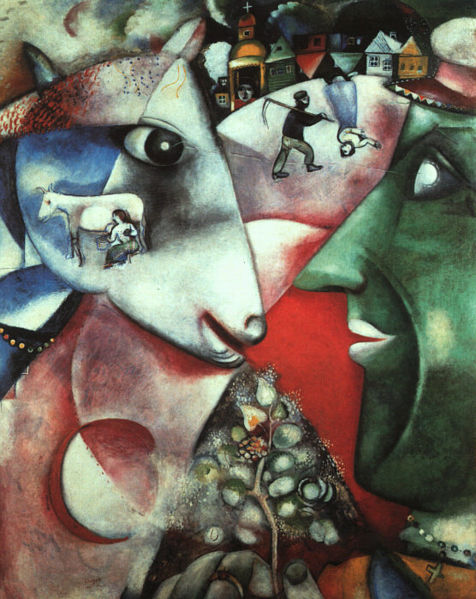
I and the Village portrays a green-faced man wearing a cross necklace, a cap on his head and holding a glowing tree. He stands in the foreground of the painting making eye-contact with a goat, with another smaller goat being milked.
The background contains a number of unusual figures, including a man carrying a scythe, an upside down violinist, a row of houses, and an Orthodox church – not so surprising therefore that he might have been seen to be a Surrealist.
There are a number of geometric shapes within the painting – the three circles are said to represent three spatial wonders: the sun’s revolution in orbit, the earth’s revolution around the sun and the moon’s revolution around the earth. This theory was taken a step further by suggesting the smaller circle in the lower left-hand corner as an eclipse.
Chagall was soon exhibiting at the Salon des Indépendants; however his work was not selling well, as his paintings were viewed as being neither Impressionist nor Cubist.
Of course it soon became clear that he was drawing on a number of influences to create his unique approach. Even though leading Surrealists like André Breton claimed him as one of their own, Chagall continually resisted, claiming, ‘I want an art of the earth and not merely an art of the head.’
Obviously Chagall’s work could not be simply incorporated into a particular art movement, and at the age of thirty-five he finished writing his autobiography, My Life, in an effort to better explain his work.
During one of his brief visits to Russia, Chagall met Bella Rosenfeld, a beautiful and well-educated daughter of one of the town’s wealthiest families. They soon married, but after the outbreak of World War I they were obliged to remain in Russia for the next nine years. During this time, he had to accept a teaching position within the Commissar of Arts for Vitebsk.
The couple eventually moved back to Paris but with the approach of World War II, many Jewish artists began to seek refuge in the United States. This became particularly vital for Chagall, as Hitler’s deputy Joseph Goebbels had personally ordered Chagall’s paintings to be burned.
Fortunately, Chagall’s name was added to a list of European artists whose lives were at risk and in need of asylum, and Chagall and Bella were able to move to New York. Bella died from a viral infection just before the war ended, greatly affecting Chagall. He found it difficult to work and decided to move back to France in 1947 where he settled in Vence.
He continued to paint, but his work would never again achieve his earlier mastery. He took on a number of large scale commissions – stained-glass windows for the United Nations Peace memorial in New York, and The America Windows for the Chicago Institute of Art – both presented as gratitude for his brief asylum in the United States.
In 1985, Chagall died aged ninety-seven. During his career he had produced approximately ten thousand works, and many fine ones.
But the most extraordinary were undoubtedly created from his visions of village life in Vitebsk.