
Igor Stravinsky, 1946
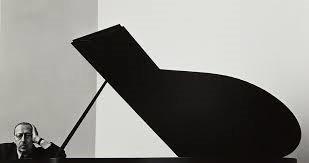
Arnold Newman was seen as thecreator of environmental portraiture. As he explained, ‘I didn’t just want to make a photograph with some things in the background. The surroundings had to add to the composition and the understanding of the person. No matter who the subject was, it had to be an interesting photograph. Just to simply do a portrait of a famous person doesn’t mean a thing.’
The results he was able to achieve are strikingly evident in the photograph seen here of the composer Igor Stravinsky, taken in 1946. The image is almost monotone, dominated by the stark geometric contrast between the white wall and the black piano. Newman deliberately used the open lid of the piano because he felt “It is like the shape of a musical flat symbol—strong, linear, and beautiful, just like Stravinsky’s work.”
His dramatic cropping of the composition was a key technique that Newman often utilised to make for more immediate impact. He would routinely experiment with aggressive crops of his original picture, intending to maximise the overall effect.
In his extraordinary 1951 portrait of Salvador Dali, the painter is seen in the bottom left of the picture, staring at the viewer while resting his head against his upraised hand. But he is dwarfed by a dangling loops of wire that fill the scene, and seem to casually mimic his pose.
The brilliant photographer Henri Cartier-Bresson rarely allowed himself to pose for a picture, but Newman’s portrait places him against a brick graffiti-decorated wall, redolent of the candid street photography the French artist specialised in. Newman obviously intended to create a spontaneous feel, to echo his subject’s methods and style.
As he explained ‘A preoccupation with abstraction, combined with an interest in the documentation of people in their natural surroundings, was the basis upon which I built my approach to portraiture’.
Born in 1918 in New York, Newman studied art at college and went on to become a photographic assistant. Clearly even his early work was eye-catching, as he was given his own exhibition in 1941 in a noted New York gallery.
Newton managed to open his own studio by 1946 and was soon photographing fellow artists, and attracting commissions from Harper’s Bazaar, Time and Life magazines. His roll call of renowned subjects included prominent writers, film stars, political leaders, scientists, business tycoons and leading painters.
He tended to place them in their own environment or in a room he had carefully constructed to reflect their individual characteristics. By 1949 he had taken the famous photographic essay for Life magazine’s profile of Jackson Pollock in his studio, and these pictures brought great fame to both the artist and the photographer.
Newman always insisted when asked about his sitters, ‘it is what they are, not who that are that fascinates me.’ His sophistication and pioneering approach to portraiture earned him increasing admiration, and he was consistently in demand to photograph the great iconic figures of the era, be they presidents or sports stars.
Not all of his portraits were enthusiastically received by their subjects. In 1963, Newsweek magazine asked him to shoot a portrait of German industrialist Alfried Krupp. Newman knew that Krupp’s factories were notorious for using slave labour during the Nazi regime, and that his companies were a major supporter of Hitler in building armaments and munitions.
The picture emphasised Krupp’s gaunt, Machiavellian appearance, with thick brows over satanic hooded eyes. It made his satisfied smirk appear somewhat malevolent, pictured in front of a vast assembly line at one of his plants.
Obviously, the photographer made no attempt to disguise his distaste, and wanted the viewer to share it. As Newman reported ‘When he saw the photos, he said he would have me declared persona non grata in Germany’.
Newman’s ability to capture the spirit and personality of the wide variety of figures that passed before his lens earned him reverential status amongst his peers. They also respected his refusal to accept commissions to picture people he considered to be of fleeting interest, who were unlikely to be of worthwhile lasting relevance to society.
There are any number of notable portrait photographers but Newman is generally considered the most singular and inspirational of this specialist group. Perhaps this is best explained by his view that, ‘we do not take pictures with our cameras, but with our hearts and minds’.
He felt that ‘There are no rules and regulations for perfect composition. If there were we would be able to put all the information into a computer and would come out with a masterpiece. We know that’s impossible. You have to compose by the seat of your pants.
‘Photography, as we all know, is not real at all. It is an illusion of reality with which we create our own private world.’
Arnold Newman conceived a new vocabulary for photographic portraiture, according to Professor Gregory Heisler, who stated that it is difficult today to truly appreciate the magnitude of his breakthrough.
He argued that before Newman’s arrival, the photographic portrait was generally a box with somebody in the center. Newman used ‘what was around him to create visually complex, spatially intriguing portraits that had a psychological dimension. He didn’t just show the environment, he actively employed it for its narrative power’.
It is easy to wonder if contemporary masters like Annie Leibovitz could have flourished without Arnold Newman’s remarkable innovation.