
Netherlandish Proverbs
Despite portraits being a stalwart of Dutch and Flemish art in the 16th-century, and a lucrative market for artists, Pieter Bruegel never painted any.
He specialised in genre paintings portraying the lives of peasants, not a common subject matter at the time. But humanist ideals were beginning to influence artists and scholars, and Italy was coming to the end of its High Renaissance of art and culture.
Bruegel (1525-1569) was clearly an innovative pioneer in the Dutch Golden Age, and he was to become increasingly influential.
He is sometimes referred to as ‘Peasant Bruegel’ in an attempt to distinguish him from the other painters in his family, including his remarkably gifted son, Pieter Bruegel the Younger.
The epithet came about because it was believed that he must have come from humble origins, due of his emphasis on highlighting the routine working days of the lowly.
But in more recent years, scholars have noted the intellectual sophistication of his work and thinking, and believe that he was a highly-educated member of the gentry.
He travelled to Italy to see the astounding works of the Italian masters but returned to Antwerp, working as a successful print designer for the main publisher at the time. Bruegel only concentrated purely on his paintings later in life, and all of his great masterpieces were produced in little more than a decade. By then, his pictures became much sought after by wealthy patrons and collectors.
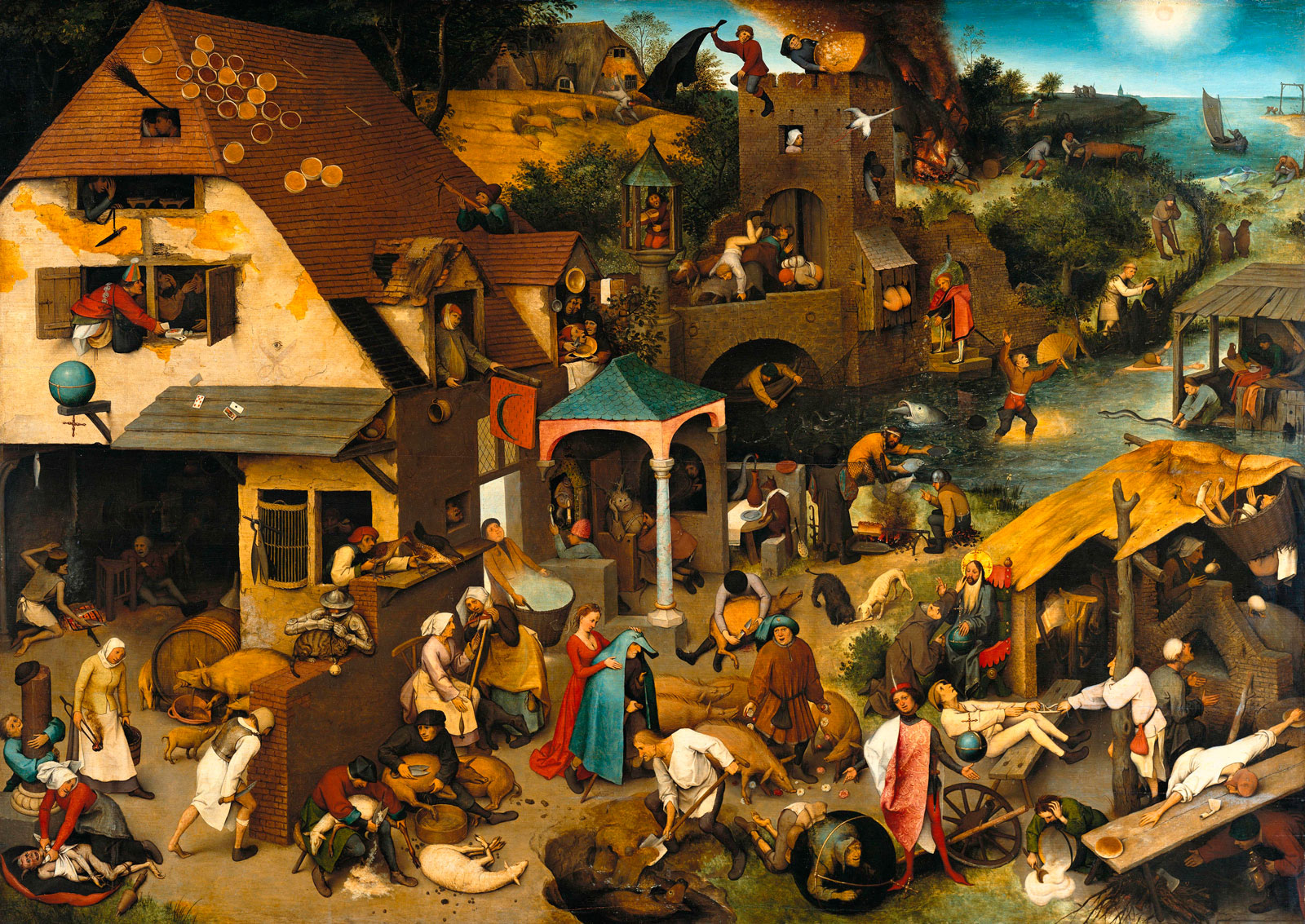
In 1559 he painted one of his most exquisite works, the richly detailedand mesmerising Netherlandish Proverbs. The Blue Cloak, as it is sometimes called, is a painting that depicts literal visual representations of more than 90 individual Dutch sayings, although the precise number is inexact, as modern interpretations of the proverbs vary.
To the people of 16thcentury Flanders, proverbs were a familiar part of their vocabulary, and as the subject of an artwork, were recognisable as well as entertaining.
Many of the depicted sayings focus on the absurdity of human behaviour, reinforced by Bruegel’s masterly and complex illustration of a densely-packed coastal town square.
The work may appear delightfully charming, but at the time viewers would note more serious implications referring to the dangers of folly, which often led to sin. Variants of a large number of the proverbs he illustrated are still used in modern Flemish, French, English and Dutch.
The proverbs are played out by the residents in the village centre, in their buildings and the surrounding landscape. Some are grotesque, some rather comical, but all are as real as the people’s behaviour. Each little scene is portrayed independently of the others.
A woman in a red dress can be seen placing a blue coat over her husband – the Dutch proverb ‘She puts the blue cloak on her husband’ meant that she cheats on, or deceives him.
In the lower left of the work, a man can be seen with his head up against a wall, signifying the expression ‘To bang one’s head against brick’.
Nearby a man in armour sits with a cat and a bell on a piece of string. There are two possible explanations which have been applied to this image. It could either be ‘To bell the cat’, meaning to carry out a dangerous or impractical plan, or else ‘To put your armour on’, meaning to be angry.
Curiously, the roof of one house can be seen littered with a number of pies, indicating that ‘To have the roof tiled with tarts’ suggests that you are very wealthy. Less appealingly, if you are to have ‘A hole in one’s roof ’ as seen in one cottage, you are thought to be unintelligent.
The detail that pervades the painting is overwhelming, with no corner of the canvas that does not convey one proverb or another. Even up in the top right nearer the horizon a man can be seen crouching down by some gallows. This is to demonstrate that ‘To crap on the gallows’ means that you are undeterred by any penalty.
A neighbour ‘Biting a pillar’ is supposedly a religious hypocrite. The little dog seen in a pot is telling you that if you arrive late for dinner, you may find all the food has been eaten. Scissors pictured outside a building – the proverb ‘The scissors hang out there’ – warns you that you a liable to be cheated inside.
A particularly clear depiction of two men side by side, one shearing a sheep and the other shearing a pig, tells us that one has all the advantages and the other has none.
Sticking to other subject matter he was most familiar with, Bruegel also painted a series of works which depicted different seasons of the year.
The Hunters in the Snow, a wonderful snowy winter landscape, pictures seemingly unsuccessful hunters returning from a recent expedition. Their dogs are by their sides, and it’s apparent from the tracks of some animal disappearing before them, they have been unsuccessful on their quest.
The powerful religious revolution taking place at the time it was painted, in 1565, led analysts to feel that Bruegel, or his patron, was aiming to convey the ideals of country life, reflected in the painting’s serene calm, immaculate brushwork, and perfect composition.
It was recorded that before Bruegel died, he told his wife to burn some of his drawings and other works which included inscriptions which ‘were too sharp or sarcastic…either out of remorse, or for fear that she might come to harm, in some way held responsible for them’. This led to speculation that they were politically provocative in a time of unrest and tension.
Fortunately, they were never found and Bruegel’s legacy remains a clear one –the creator of the some of the most powerful and sublime paintings of this era.