
New York City, 1974
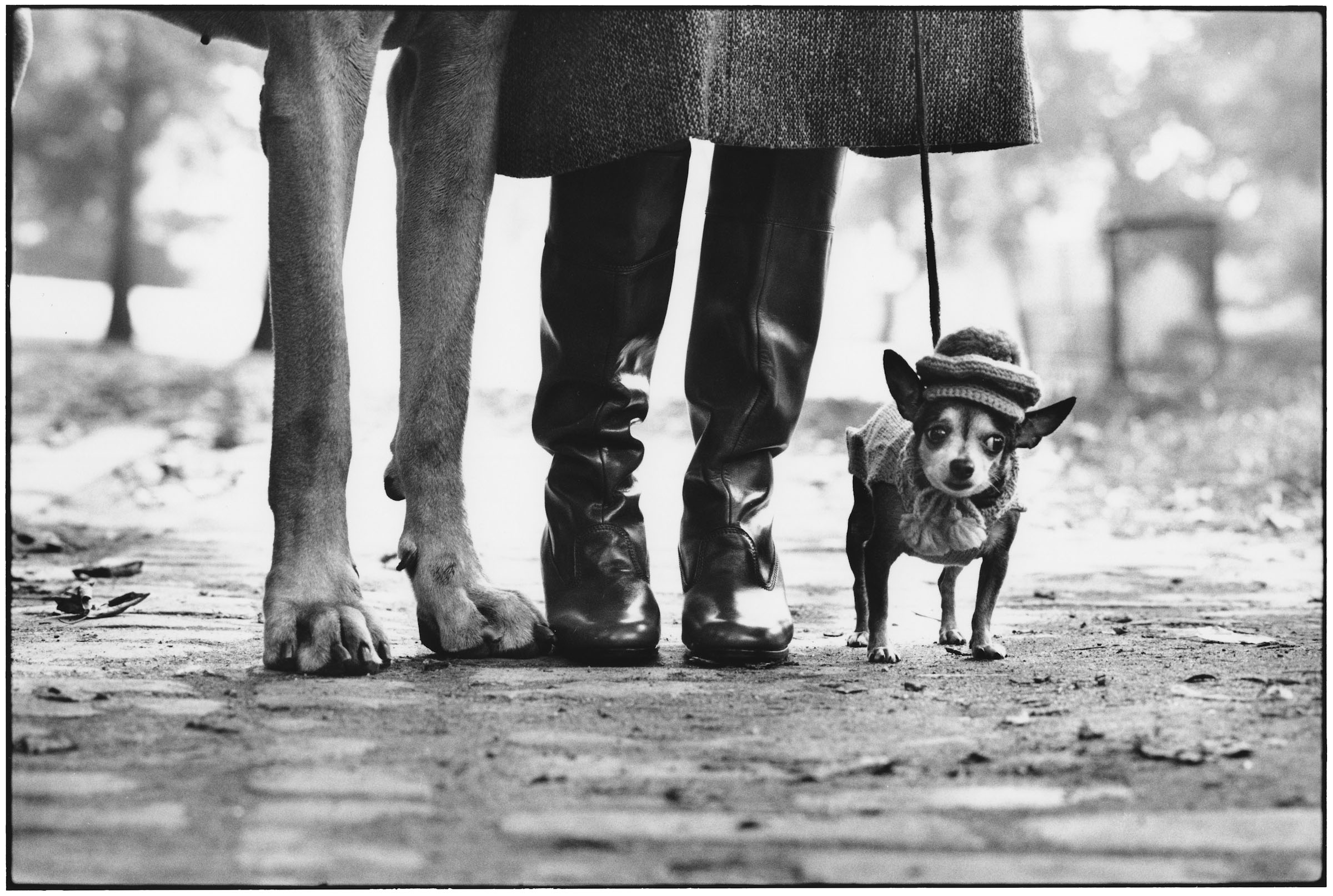
Elliott Erwitt possessed an inexhaustible sense of irony, and a sly wit, enabling him to find beauty and absurdity in tiny moments of everyday life.
As an indication of Erwitt’s quietly subversive nature, and his askance view of his profession, at the height of his much-celebrated career he invented an alter ego for himself – Andre S. Solidor.
As Solidor he produced work that was deliberately pompous and artistically pretentious. To Erwitt’s wry amusement, the pictures were regarded highly enough to have a book published, ‘The Art of Andre S. Solidor’, and for Solidor to be given a gallery exhibition.
Clearly, his overblown creation was a perfect way for Erwitt to ridicule the artistic environment he was so wary of. As he put it, ‘I’ve always been a little suspicious of the art world anyway. I thought that a lot of the art is simply what you can get away with’.
Born in France, Erwitt moved to the United States in 1939 at age ten. After completing his basic education, he found himself becoming a photographer’s assistant when he was drafted into the army and stationed in Germany. He was lucky to meet up with legendary masters like war photographer Robert Capa, and the brilliant Edward Steichen.
They both admired his ability for off-the-cuff shooting and he was soon to be invited to become a member of Magnum, the powerful agency that Capa and his partners established to represent the world’s leading photographers.
He drew immediate attention for his skill at capturing his images without hours of complex preparation, and was soon in demand by top magazines such as Life, Look and Colliers.
Erwitt’s sharp sense of observation allowed him to illustrate the warmth and humour in the smallest details of people’s daily routines, enabling simple pictures to convey a memorable story. His hard-hitting social studies were also much respected, tackling subjects such as racial divide in the US.
In a blisteringly graphic picture taken in North Carolina in 1950, a black man is pictured washing his hands at a crude sink marked ‘Colored’, with an empty, larger and well-constructed sink nearby, marked ‘White’.
Erwitt’s fascination with dogs became an abiding subject matter for several decades. Although viewers found these pictures appealing, and far removed from the raw documentation of other leading Magnum photographers, he was considered the equal of his most illustrious fellow members.
He pointed out that he felt no particular fondness for dogs, but enjoyed taking pictures of them ‘because they don’t complain, don’t make you sign releases, and don’t bother you’.
This was indicative of his very different approach, which relied on humour to present a captivating story in a single frame. His perspective was that ‘making people laugh is one of the highest achievements you can have. It’s difficult: that’s what I like about it.’ As he enigmatically explained about his general technique, ‘I am not a serious photographer like most of my colleagues. That is to say I am serious about not being serious.’
Of course, his career was built on more traditional lines, taking totemic black and white portraits of Marilyn Monroe, Che Guevara, Fidel Castro and Jaqueline Kennedy, as well as commercial photographs for advertisers. His touching photo of Mrs Kennedy at the funeral of her husband, following his assassination in 1963, became one of the most poignant images of the era.
Thanks to his affiliation with Magnum, he was offered constant work documenting Hollywood films in production, including On the Waterfront and The Seven Year Itch. His revealing studies of Marlon Brando became especially notable.
In the picture here, more prosaically, two dogs are the main protagonists. The tiny fashionably-dressed Chihuahua, wearing a slightly foolish-looking beret, stares balefully at us as it stands beneath its owner, who is cropped to reveal only her towering leather boots. But the surprise punch of the image is on your second take, when you see that on the left are another pair of legs the size of tree trunks, belonging to a Great Dane standing alongside.
Often his photographs became universal, like the picture of a young man riding a bicycle, carrying a boy behind and two loaves of French bread tied to the back. This picture was used on so many t-shirts, cups and notebook covers that it lost all ties to Erwitt, and few people were ever aware of the photographer of this deliberately casual, yet utterly charming work. More famously, perhaps, his picture of Richard Nixon poking Russian President Krushchev became an indelible Erwitt image.
Much of his work appears at first look to be slight and inconsequential, but his genius becomes clear when we realise a simple picture of a glance between two people provides an intimate insight into their relationship. It was his fascination with the foibles of modern society that propelled him to always seek the most telling way to tell a tale.
As he explained, ‘To me, photography is an art of observation. It’s about finding something interesting in an ordinary place. I’ve found it has little to do with the things you see and everything to do with the way you see them. You just have to care about what’s around you and have a concern with humanity and the human comedy’.
Even in old age Erwitt was still in demand, and today, at 90-years-old, he is regularly being honoured with retrospective exhibitions at the world’s leading museums. But being Elliott Erwitt, he probably takes the adulation with the same sense of irony as he did when creating the success of his fictitious Solidor.