
One: Number 31
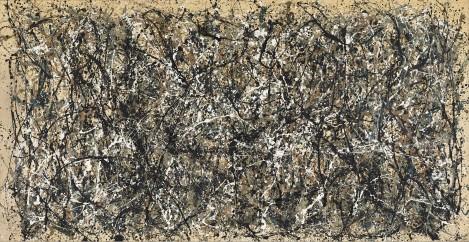
Even Pollock felt disconcerted when he looked at his first drip canvas.
His technique was so utterly different from traditional painting, he called out for his wife, artist Lee Krasner, to come to his studio.
Instead of enquiring whether it was a good or a bad work, he asked ’Is this a painting?’ Pollock (1912- 1956) was exhilarated but perplexed, unsure of what he had created.
Instead of painting in the conventional way, Pollock laid the canvas on the floor and used sticks, stiffened brushes and even turkey basters to pour, drip and flick his enamel paint onto the canvas.
Occasionally, he even squeezed paint tubes and made holes in the bottom of paint cans, splattering thick paint in muted colours onto his seemingly chaotic picture.
He explained that he chose to paint on an unstretched canvas on the floor, since this helped him walk around all four sides of it. Now able to sense that he himself was part of the painting,
Pollock felt he could connect directly with it, immersed unhindered in the freedom of what he was attempting.
The leading critic Harold Rosenberg quickly introduced the term ‘action painting’. His view, directly linked to Pollock’s work, was that action painters viewed their canvases as an ‘arena’ in which they could perform and act, emphasising that ‘“what was to go on the canvas was not a picture but an event.’ This was the beginnings of Abstract Expressionism.
In the summer and autumn of 1950, Pollock made three similar mural sized paintings, of which One: Number 31 was the first.
Filled with stark contrasts, in some areas the paint is applied so thinly that it merely stains the canvas, while in other parts of the canvas it is extremely dense and has dried with a clotted and creased texture.
Abstract Expressionists during that time were presented as painters of raw power rather than of elegant sophistication – at the forefront of an ‘aggressive spirit of revolt’, referencing Pollock’s ‘bursting masculinity’.
Another important critic, Clement Greenberg, who had once termed Pollock’s early paintings ‘close to prettiness’ and resembling ‘wallpaper patterns’, had now become a vociferous convert.
When making direct comparisons to other leading artists, he found Pollock radical, tough and ruthless, whereas others were traditional easel painters. Pollock was seen as proposing a rugged and brutal image of American art compared to the ‘visually effeminate’ popular French art of the period.
Other artists spoke respectfully of how ‘violent’ his expressive paintings were, and that it required ‘strength’ to paint in such a manner.This image of Pollock was also enhanced by his use of cheap matt and gloss enamel, with the artist explaining that he began using industrial synthetic paint as ‘a natural growth out of a need’.
‘No Chaos, Damn It’ was the reply Jackson Pollock sent to
Time magazine following an article published in 1950 about his paintings headlined ‘Chaos, damn it!’
Of course Pollock became an overnight star when the magazine appeared, asking, ‘Is he the greatest living painter in the United States?’
Readers were incredulous, which in turn instigated critical debate and discussion of ‘What is art?’ and ‘Is that art?’
Though Pollock was initially somewhat hesitant about the article, he eventually grew so delighted at the hoopla it created that copies of Time were distributed at the launch of his exhibition at the Betty Parsons Gallery.
It was here that One was first exhibited in November 1950 with thirty other paintings, stretching from ceiling to floor.
The opening was quite a successful affair owing to Pollock’s recent notoriety.
One was hung opposite his painting Autumn Rhythm and took up an entire wall. Some compared the experience to being hit by a meteor shower when they took in these majestic paintings, their infinite flow and energy limited only by the edges of the canvas.
Obviously, the paintings caused a stir, but they were far from well-received by most critics, some stating that One and Autumn Rhythm were ‘meaningless’. He sold only one painting, the magnificent Lavender Mist during this exhibition.
But Pollock was far from confident about his work, even his basic abilities. When he was eighteen he wrote a letter to his oldest brother stating: ‘my drawing I will tell you frankly is rotten. It seems to lack freedom and rhythm.’
Of course his drip paintings were later to be considered the embodiments of freedom and rhythm.
One: Number 31 was made by Pollock approximately three years after he began painting in this style.
One of Pollock’s largest works, it was a revolutionary placard, a billboard of Pollock’s commitment to instigate a new way of viewing painting, that deterred people from grasping every minute detail as they would with traditional paintings.
However nothing eased his self-doubt, and he grew increasingly depressed and began drinking heavily, often all night in the legendary artists’ bar, the Cedar Street Tavern.
There he would regularly find himself in violent rows about art with de Kooning, Motherwell, Rothko, and Kline.
He painted when he was sober, and his most breath-taking works painted between 1948 and 1951 were produced when he managed to stop drinking completely.
In 1951 at the height of his career, Vogue published a three-page article on Pollock titled ‘American Fashion: The New Soft Look’. Cecil Beaton had taken pictures in which Pollock’s radical drip paintings served as decorative backdrops for models dressed in evening gowns.
His long-standing uncertainty about his drip paintings and his dread of being considered a ‘decorative’ artist intensified.
Haunted by depression and alcoholism, Pollock died at the age of forty-four, driving his car drunkenly into a tree one mile away from his home.
The year after his death in 1956, a retrospective exhibition of Pollock was held at the Museum of Modern Art in New York.
One is now in the collection of MoMA and is deemed the most electrifying and revolutionary work of its generation, still commanding an awed reaction from visitors. With their all-over composition, the direct, complex, powerful yet controlled ‘drip’ paintings announced the birth of Abstract Expressionism, and became a 20th-century landmark in the history of painting.