
Pietà
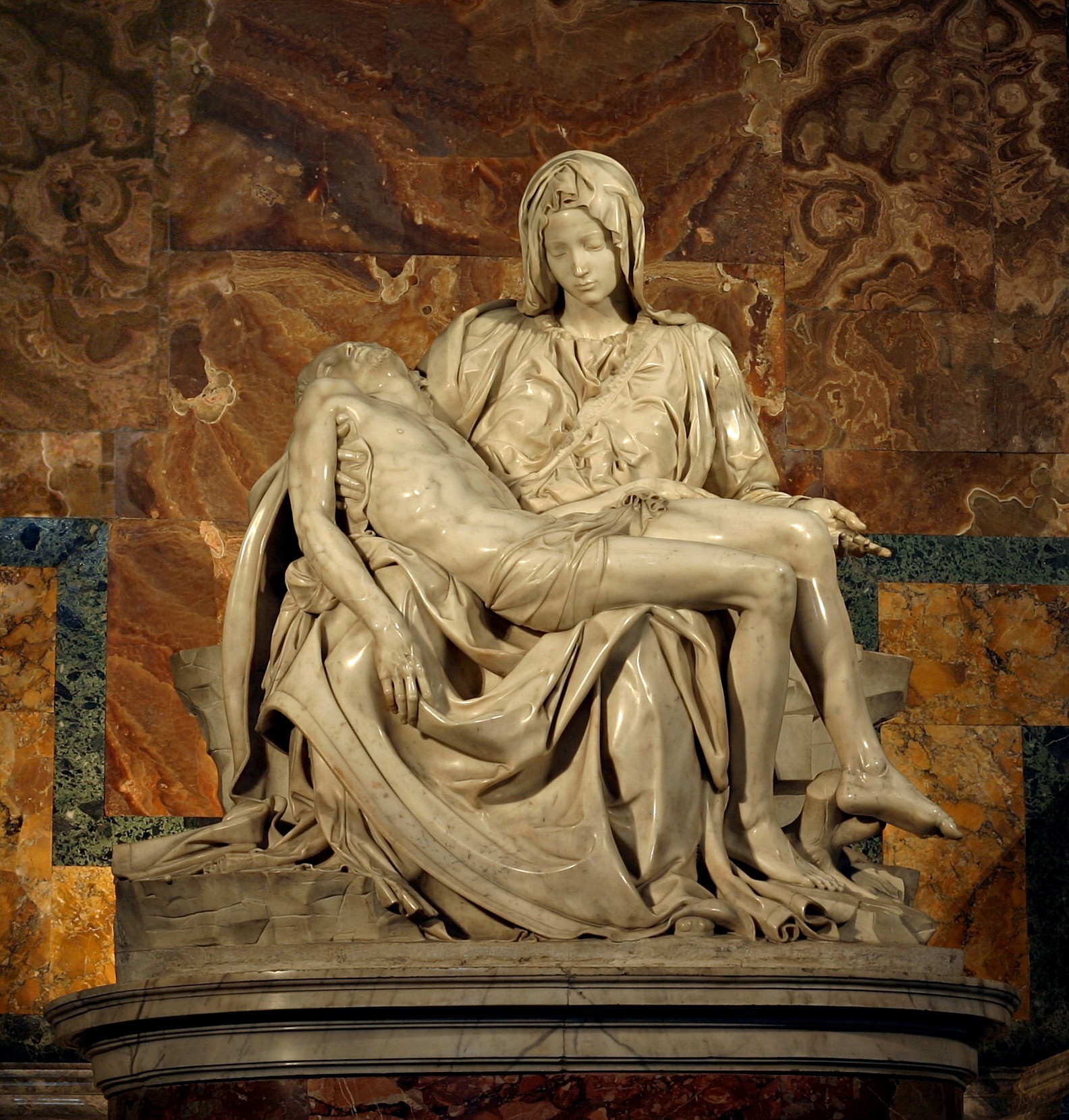
Was Michelangelo’s Pietà his greatest ever achievement, more majestic than his sculpture David, more wondrous than his Sistine Chapel ceiling?
Since its creation in 1499, debate about the genius of Michelangelo (1475-1564) has seen countless historians argue the relative merits of these three extraordinary works, the pinnacles of the Renaissance.
He was only 24 when Cardinal Jean de Bilhères commissioned him to make a memorial for his tomb that would ensure a suitable legacy. The cardinal specifically wanted it to feature the Virgin Mary taking Jesus down from the cross.
But he was firm about his ambition for the sculpture, so that it would properly reflect his great standing. ‘It must be the most beautiful work of marble in Rome’ was the daunting brief for the young artist.
Michelangelo was confident he was up to the task. He chose to carve the vast statue out of a single slab of Carrera marble, securing the most perfect block he had ever seen.
He had previously worked on a number of works for the all-powerful Medici family in Florence, and had been contacted about the Cardinal’s wishes when he moved to Rome in 1496.
Multi-figured sculptures were rare at the time, and Michelangelo’s creation was particularly sublime.
Mary’s devastation is portrayed in all its sadness, though she remains tranquil in tragic acceptance of the death of her son. Christ also appears peaceful in death, rather than a man who has been tortured so horrifically until he expired.
Pieta stunned viewers the moment it was revealed. The Virgin Mary holding the dead body of Christ was not an unknown subject matter, but never before had it been portrayed so movingly.
In fact, the vast majority of Michelangelo’s art focused on religious themes; he was a pious man, and clearly drew power from his profound faith.
Pieta is unique in mixing essentially Gothic subject matter with Renaissance ideologies. Inspired by naturalism, Michelangelo utilised a sense of classic harmony, presenting Mary with the youthful features of her younger self, a beautiful young lady rather than the mother of fully grown man.
Clearly, he wanted to convey the biblical admiration for the timeless sanctity of chaste women, and of course Mary was a virgin.
The two figures are disproportionately sized. Mary has been modelled comparatively larger than the wiry, yet more diminutive figure of Jesus, overcoming the technical difficulties of having a young woman cradle a man convincingly, without appearing dwarfed.
Formed in a pyramid shape, it allows Mary’s head to be smaller and delicate, before the sculpture expands out to wonderfully carved folds of cloth at her body and lap, creating visually perfect dimensions as the work is viewed.
If you look closely, the sculptor’s signature can be found across Mary’s chest. The chronicler of the Renaissance, Vasari, wrote that; ‘One day Michelangelo entering the place where it was set up, found there a great number of strangers from Lombardy, who were praising it highly, and one of them asked one of the others who had done it, and he answered, ‘Our Gobbo from Milan.’
‘Michelangelo stood silent, but thought it something strange that his labours should be attributed to another; and one night he shut himself in there, and, having brought a little light and his chisels, carved his name upon it’.
Michelangelo later regretted the vanity of this act, and resolved never to sign another piece of his work.
By the time Michelangelo returned to Florence, his reputation had soared. He was asked by the city leaders to create a statue of biblical hero David, a project which two prior sculptors had previously attempted and abandoned.
He found a long-abandoned massive block of marble, and turned it into the most dominating sculpture ever seen.
His 17ft tall David reveals his figure’s strength and sinewy musculature, as well as the vulnerability of his nakedness. His gently human expression made the work the prized representative of Florence. It remains so to this day.
Several commissions followed, including an ambitious project for the tomb of Pope Julius II, but this was suddenly interrupted when the sitting Pope, sensing Michelangelo’s genius, was determined to have Michelangelo switch from sculpture to an overwhelming new task.
He was to paint the ceiling of the Sistine Chapel; as you know, this was to become one of the world’s most totemic and beloved works of art.
Looking back to Michelangelo’s beginnings, few could have guessed he would be one day recognised as such a luminary.
Born in 1475 in the little village of Caprese, due to his mother’s illness he was placed with a family of stonecutters, and he fondly remembered; ‘With my wet-nurses milk, I sucked the hammer and chisels I use for my statues.’
His mother died when he was six, and his father showed little interest in his son pursuing any ambition to become an artist. Fortunately he eventually relented, and at 13 the boy became an apprentice to Ghirlandaio, the renowned muralist.
Young Michelangelo’s talent must have been prodigious even as a young teenager, and he drew the attention of Florence’s most powerful family and art patrons, the Medici. Lorenzo Medici, who rather enjoyed his sobriquet ‘Lorenzo the Magnificent’ extended an invitation for Michelangelo to work in a studio within the Medici palace.
Here he was surrounded by a breathtaking collection of art and artefacts, and particularly fine examples of ancient roman sculpture; they obviously fired his imagination in the decades to come.
One of the results of being considered the foremost virtuoso of his day, revered more even than Leonardo da Vinci, was that he became the first artist whose full biography would be written in his lifetime. In fact, there were three different biographies, including the entire final chapter of Vasari’s ‘The Lives of the Artists’.
In terms of posterity, Michelangelo has always been regarded as one of mankind’s most exalted creators, alongside Shakespeare and Beethoven, who were able to express the joyfulness and anguish of humanity with such depth.
Perhaps because of his utter singularity, Michelangelo’s visual influence on future art could be considered relatively limited, with other Renaissance artists on the pantheon of greats, such as Raphael and da Vinci, having an enduring effect on art that followed. It may be that Michelangelo is associated with such cosmic grandeur, his authority was simply too inhibiting.