
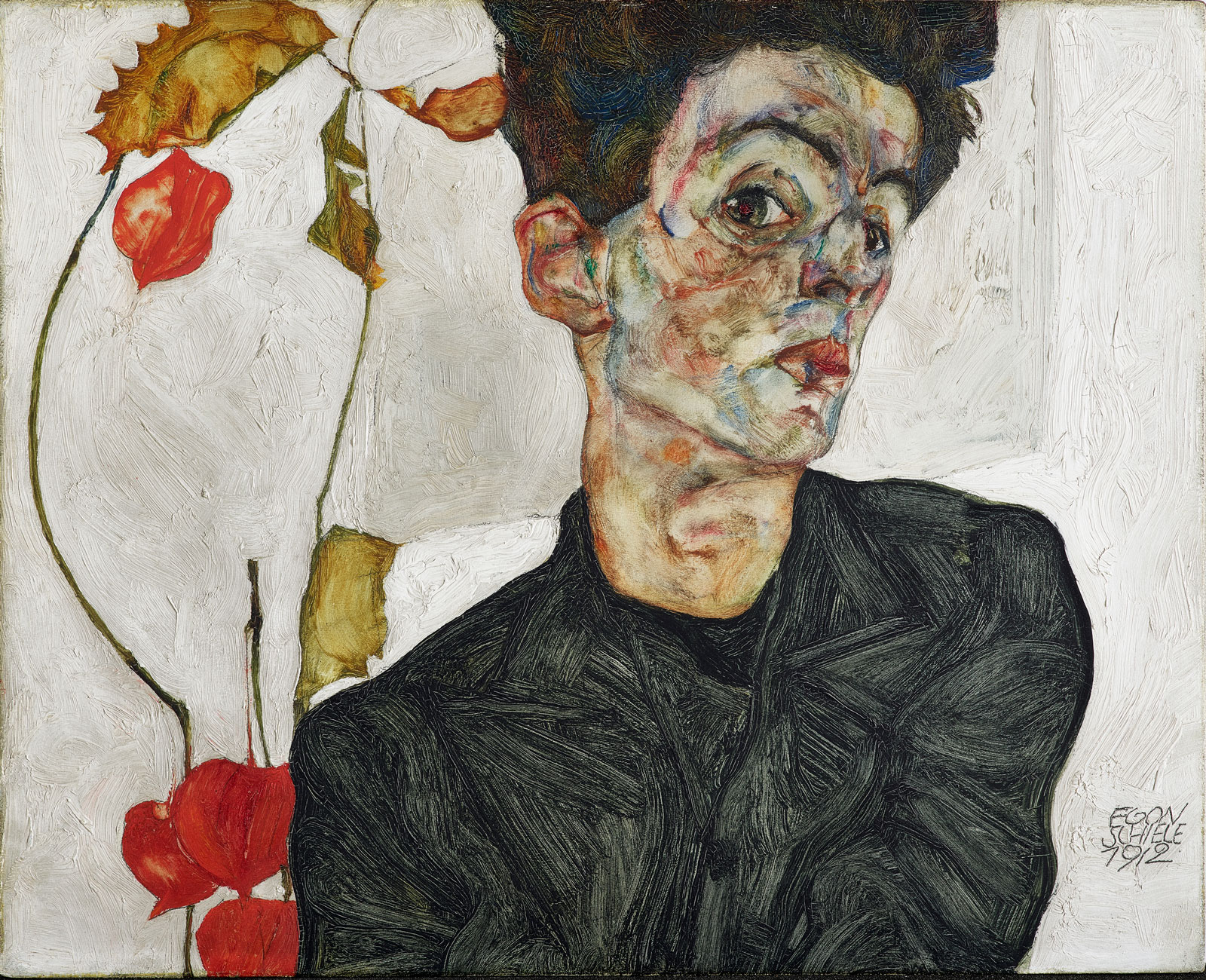
Self-portrait with Physalis
Egon Schiele had a brief, calamitous life, dead at 28.
‘The Cursed Artist’ found each of his days more turbulent than the last, until he became a victim of Europe’s Spanish Flu pandemic that reached Vienna in 1920.
Growing up, he watched his father’s mental health deteriorate, a sister die aged ten, his mother lose a daughter at birth, and then lose another a year later – it was a morbidly bleak upbringing for an already hypersensitive young man.
In his painting ‘Dead Mother’, completed when he was 20, he was clearly still traumatised by his mother’s suffering, creating the moving image of a parent seen with her stillborn child, as she lays with the foetus in a pool of amniotic fluid.
In 1906, Schiele had enrolled in Vienna’s Academy of Fine Art, where his natural gifts quickly became apparent. His fearsome professor, Mr Griepenkerl, was asked about the boy’s abilities, and replied: “Does he have talent? Yes, too much. He messes up the entire class.”
Soon to be seen as a natural member of the Austrian Secession movement, he had become a protégé of its leader, the great Gustav Klimt. But despite the majestic grandeur of Klimt’s painting, Schiele wanted to emphasise raw expression rather than strive for the radiance of his tutor’s work.
He was particularly inspired by the young female form, and conveniently, his sister allowed him to study the evolution of her body.
A revelatory painting from this time was ‘Portrait of Gerti Schiele’. She is seen against a stark, blank background, monochrome and unadorned, the graphic power of his drawing translated dramatically in paint.
After he met Valerie Neuzil, a young 17-year-old model for Klimt, she became his mistress, and muse for many of his greatest portraits. She appears in a number of his psychologically-charged works, routinely named ‘Wally’.
His efforts were becoming recognised by his peers, who were struck by its sombre palette, irregular contours and dark symbolism. He still regarded drawing as his primary art form, captivated by its immediacy, and this translated into paintings with an emphasis on contour and striking draughtsmanship.
Schiele’s attraction to youthful girls, and the intense sexual directness of his drawings and paintings were soon to put him at the centre of an endless series of scandals.
He was accused of the corruption of minors and public immorality, as it became clear that his models were sometimes only 15. Many of his works were confiscated for being debauched, and he was even jailed for three weeks, with the judge burning one of the offending pictures over a candle flame.
His time in prison resulted in Schiele producing a series of twelve remarkable paintings depicting the humiliation and discomforts of being locked in a cell.
Generally, the subjects in many of the works created by Schiele during his career are seen frozen in unconventional and overwrought poses – distorted, with grimacing faces, and unsettling angles for the body and hands.
They were certainly uncomfortable to look at, but his intention was to portray the anguished interior life he sensed within his subjects. Of course his own searing self-portraits were equally tormented, often depicting himself naked in fully revealing confrontations with the viewer.
Schiele expresses himself perfectly in his Self-Portrait with Physalis, appearing both cockily self-confident, and at the same time inherently fragile.
He was clearly projecting his own inner discomforts, to create a distance and tension with the viewer.
Completed in 1912 at a period when he was producing paintings and drawings at a furious pace, his expressionistic approach seemed calmer and closer to reality.
The slender twigs of the physalis fruit, which are reminiscent of Chinese lantern flowers, act as an off-kilter backdrop; the strange biomorphic form with its thin spidery legs seems ready to envelop young Schiele.
His inclined head turns, squeezed into the cropped format, his shoulder to the right seemingly continuing the line to his jawbone. Schiele’s brushwork results in rich nuances of skin, and his enlarged eye staring down the viewer has a bright red pupil.
This startling portrait captures him just before his problems with the authorities were to descend, and his creativity sapped for the few years he was considered a pornographic rascal.
World War 1 was to have the most transformative effect on Egon’s life. Lucky not to be sent to the front lines, his primary duties in the army was to guard the Russian prisoners.
Also fortunately for him, his commanding officer allowed him access to a studio to continue painting.
Here his art continued to evolve, and appear more balanced. Bodies were no longer disjointed and tortured-looking, and he had found a wife now who became his primary model, a more mature subject than his troubled adolescents.
In 1917 the couple returned to Vienna, and found the audience for Schiele’s art was more respectful. It seems that Austrian society had decided on the artistic value of young Schiele, who was still being championed by their greatest artist Klimt.
He was soon invited to exhibit at the 49th Secession exhibition, and most of his 50 paintings displayed were sold – he was even securing portrait commissions.
Successful shows in Zurich, Prague and Dresden followed, and he was now being widely acknowledged as a gifted young talent of great note. But his triumph of achieving widespread acceptance and respect was to be a short lived.
Within a year, his wife was to die from the flu epidemic that had claimed 20 million lives in Europe, with Schiele following her three days later.