
Study after Velázquez’s Pope Innocent X
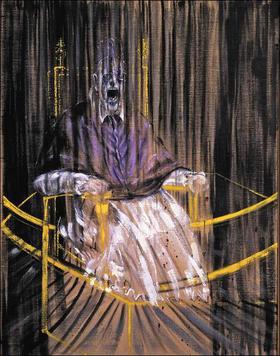
Francis Bacon worked on variations of Velázquez’s portrait of Pope Innocent X for over twenty years.
Although he studied endless reproductions of the Velázquez painting in books, he didn’t see the original until he visited Rome in 1954.
Bacon (1909-1992) had long depicted his view of the human condition, creating distorted and tormented images, but his screeching Popes would go further, suggesting a great deal about the artist’s desires, motivations and obsessions.
His fascination with the Velázquez original was understandable, as for him and its many other admirers, it is one of the greatest portraits ever painted.
At first glance the Velásquez Pope appears to stare directly towards the viewer with a stern and powerful gaze, also marked by the tilted eyebrows and tightly shut lips.
But looked at for a moment longer the eyes soon become weary and uncertain, appearing to be seeking something unknown.
In Bacon’s Study after Velázquez’s Pope Innocent X, and in his other forty-eight versions of this subject, he dramatically alters and blurs the painting, most notably by making the Pope shriek wildly.
The great art historian David Sylvester asked Bacon about his Pope paintings: ‘The open mouths – are they always meant to be a scream?’
Bacon replied, ‘I’ve always been very moved by the movements of the mouth and the shape of the mouth and the teeth.
‘People say these have all sorts of sexual implications, and I was always very obsessed by the glitter and colour that comes from the mouth. I’ve always hoped in a sense to be able to paint the mouth like Monet painted a sunset.’
The scream also references the Odessa Steps sequence in the classic silent film Battleship Potemkin, which Bacon was entranced by. In the scene, a nurse cries out in horror as she is shot in the eye through her spectacles.
The red blood-like little paint splatters on the Pope’s robe are also related to this imagery. The Pope sits mounted on a throne, which in Bacon’s painting appears to be more like an electric chair, pictured howling in anguish as he is being taken from this world into the next.
The yellow lines surrounding the figure form not just the seat, but fan out to also be read as a boxing or wrestling ring, a familiar theme in several of Bacon’s works. Sylvester enquired: ‘The Pope … is it Papa?’
Bacon’s feelings towards his father were revealing: ‘Well, I disliked him, but I was sexually attracted to him when I was young. When I first sensed it, I hardly knew it was sexual. It was only later, through the grooms and the people in the stables I had affairs with that I realised that it was a sexual thing towards my father.’
Tormented as an adolescent, Bacon later depicted tragedy, fear and desire in his paintings, and observers found this unsurprising given his life was one of conflict and emotional turmoil. He was aware from a young age of his sexual inclination but would condemn himself for it, referring to his homosexuality as ‘a defect’ and a ‘limp’.
After his father caught him wearing his mother’s underwear, he had him whipped by the stable hands, whom according to Bacon he later had sexual affairs with.
Bacon Sr. sent him away at the age of sixteen to live with an uncle in Berlin to ‘straighten the boy out’. Instead, the uncle used the young Bacon as a sex toy, only to then abandon him in the city.
In 1927, during his first year after moving to Paris, Bacon pored over one hundred of Picasso’s drawings. He believed Picasso had got to ‘the core of what feeling is about’.
It was at this moment Bacon decided to start painting. ‘He became the reason I paint “the father figure”.’
With little attention drawn to his work back in London, by the late 1930s he had stopped painting. He abandoned himself with fervour to simply drifting, from bar to bar, from person to person.
In 1952, Bacon met former RAF pilot Peter Lacy, who was to become his perfect ‘cruel father’. Bacon had never experienced feelings like those he felt for Lacy, an all-consuming passion, unable to live with or without.
‘Being in love in that extreme way,’ he said, ‘being totally obsessed by someone, is like having some dreadful disease. I wouldn’t wish it on my worst enemy.’
Together they travelled to Tangier, a gay haven for British and American men who wanted boys and drugs during the 1950s. It was here that Allen Ginsberg, William Burroughs and Joe Orton would often join Bacon and Lacy.
Experimenting with S&M wouldn’t be the most painful torment Bacon would suffer at the hands of his lover – it would be Lacy’s death. In May 1962, the day before Bacon’s first Tate retrospective opened, he learned Lacy had been found dead, almost certainly from one alcohol binge too many.
Utterly heartbroken and solitary, it was two years later before Bacon encountered George Dyer; they met after Dyer broke into his studio to rob him. Not unlike Bacon’s previous relationships the next seven years were characterised by violent conflict.
History was to repeat itself and in 1971, the day before the opening of Bacon’s retrospective at the Grand Palais in Paris, when Dyer overdosed on drugs and died in their Paris hotel room.
Now aged sixty-one, Bacon was desolate and inconsolable. In his final interview, Bacon admitted, ‘I painted to be loved,’ but sadly from the day his father abandoned him, his was to be a story of heartless hero figures, tempestuous lovers, and loss. His turbulent years are manifest in his searing, monumental paintings; perhaps his remarkable triptychs represent the clearest understanding of the convulsed life of one of the 20th century’s most remarkable men.