
The Battle of San Romano
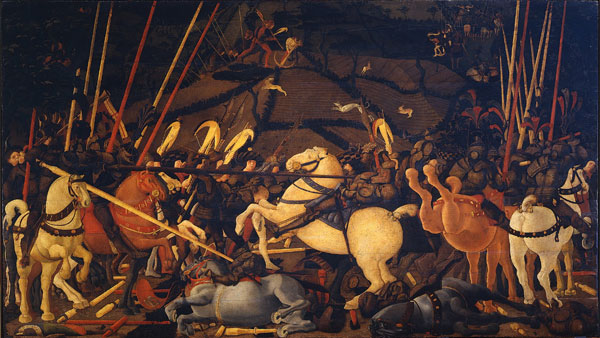
Paulo di Dono was best known by his nickname Uccello – the bird.
This was perhaps unsurprising, as he had passed his childhood endlessly working on illustrations of swallows, swifts and house martins.
Born in Florence in 1397, Paulo Uccello later developed another obsession – the wonder of utilising perspective in his drawings. Days and nights were consumed with sketching objects in order to fully master foreshortening, calculating the perfect vanishing point for each image.
When his wife called him to come to bed after he had spent many hours wrestling with his experiments, Paulo replied; ‘Oh what a wonderful thing this perspective is!’
He had begun his artistic apprenticeship with the prominent metalworker Lorenzo Ghiberti when he was ten. Within seven years, Uccello’s remarkable talents had become so clear, he was admitted to the distinguished Florentine Painters’ Guild.
Young Paulo immediately began to find ways to reconcile the decorative, late Gothic style with the radical new thinking emerging with the birth of the Renaissance.
Sadly, almost nothing of his early work remains. His first frescoes in Santa Maria Novella are badly damaged, although his concerns with elegant linear composition are still apparent in the painting that remains. Even the mosaic works he produced when he moved to Venice for six years are lost.
He received a commission returning him to Florence, when he was offered the task of creating a series of pictures depicting scenes of monastic legends for the cloister of San Miniato al Monte. Though these are also in extremely poor condition, they demonstrate Uccello’s grasp of simplified, monumentally contoured forms, inspired by his close friendship with the foremost sculptor of the day, Donatello.
Other important commissions followed for Florence Cathedral, where his depiction of a horse and rider was highly-regarded – commentators admired the energy Uccello had managed to convey in the horse, and were stunned by the painting’s startling single-point thrust, and the convincing sculptural reality he was able to bring to the picture.
Uccello went on to create a tour de force with his first pioneering masterpiece, The Flood in 1447. Its perfect harmony established him as a true master of visual perspective, with his creation of a heightened sense of depth in his paintings.
When he was subsequently asked by the powerful and wealthy Bartoloni Salimbeni family to complete a group of three large paintings, his reputation rose greatly. The pictures were intended to commemorate a great battle in which the Florentine army had defeated the forces of mighty Sienna.
The resulting three triumphant works were so majestic, so thrillingly painted, they were soon to be recognised as one of the highest pinnacles of the Italian Renaissance.
They certainly caught the eye of Lorenzo de Medici, the legendary art patron and unrivalled driving force of the era, who managed to acquire all three by offering an irresistible price. They were installed at the Medici Palace, surrounded by his other great jewels of painting and sculpture, all of which are now the highlights of every important museum collection in the world.
Uccello’s three depictions of the battle have of course been separated over the centuries and they reside prominently today on the walls of London’s National Gallery, the Louvre in Paris, and the incomparable Uffizi Museum in Florence.
The pictures capture various stages of the battle in meticulous detail, amongst the most precise and complex works of linear perspective ever seen. They certainly introduced a new subject into 15th century art – a war zone.
Uccello was probably expected to produce a celebratory portrait of the successful Florentine army officers, but he ignored that notion as being too pedestrian. Instead, he gathered together as many eye witnesses as possible to describe the eight-hour fight, to detail the ebb and flow of the opposing forces, the attacks and counter attacks, the manoeuvring of troops, the reaction of the soldiers during each step of the battle.
The paintings move from dawn to dusk in a frenzied clash of mounted cavalry, lances and swords chaotically thrust everywhere, in fear and desperation.
In many ways the pictures suggest the grandeur and pageantry of an enormous jousting tournament, with no gory realities of blood being spilled, or piled corpses of fallen warriors.
In fact, the paintings are somewhat decorative, emphasising the fine gilded armour and silvered chain mail. Even the horses appear resplendent with their elaborate saddles and shiny coats. The Florentine general wears a red and gold velvet brocade hat, rather than a helmet, suggesting his confidence in the outcome of the day.
Using bewitching colour effects, Uccello presents the drama as an intricate narrative, formed with criss-crossing patterns of lances, and light flashing back and forth across the burnished shields.
Each overwhelming panel measures over ten feet wide, painted in egg tempera on wood, and they have survived comparatively well over the centuries.
Overall Uccello’s work indicates a meticulous, analytic approach, driven by the application of scientific laws to create three dimensional detail. His grasp of the enhanced realism that he could now bring to art was to influence other renaissance masters including Piero della Francesca and Leonardo da Vinci.
In fact, his significance was considered parallel to the genius of Masaccio. Both helped usher in this new way of seeing, a vital component that enabled Italy’s Renaissance to advance forward, transfixing artists across much of Europe.
The legendary 16th-century chronicler of artistic titans, Giorgio Vasari, pronounced that Uccello was “intoxicated” by perspective.
In later years, analysts of the period considered that it was the transcendent beauty of Uccello’s compositions had been an even greater contribution.