
The Descent from the Cross
Peter Paul Rubens was never accused of being self-effacing.
‘My talent is such that no undertaking, however vast in size, has ever surpassed my courage.’
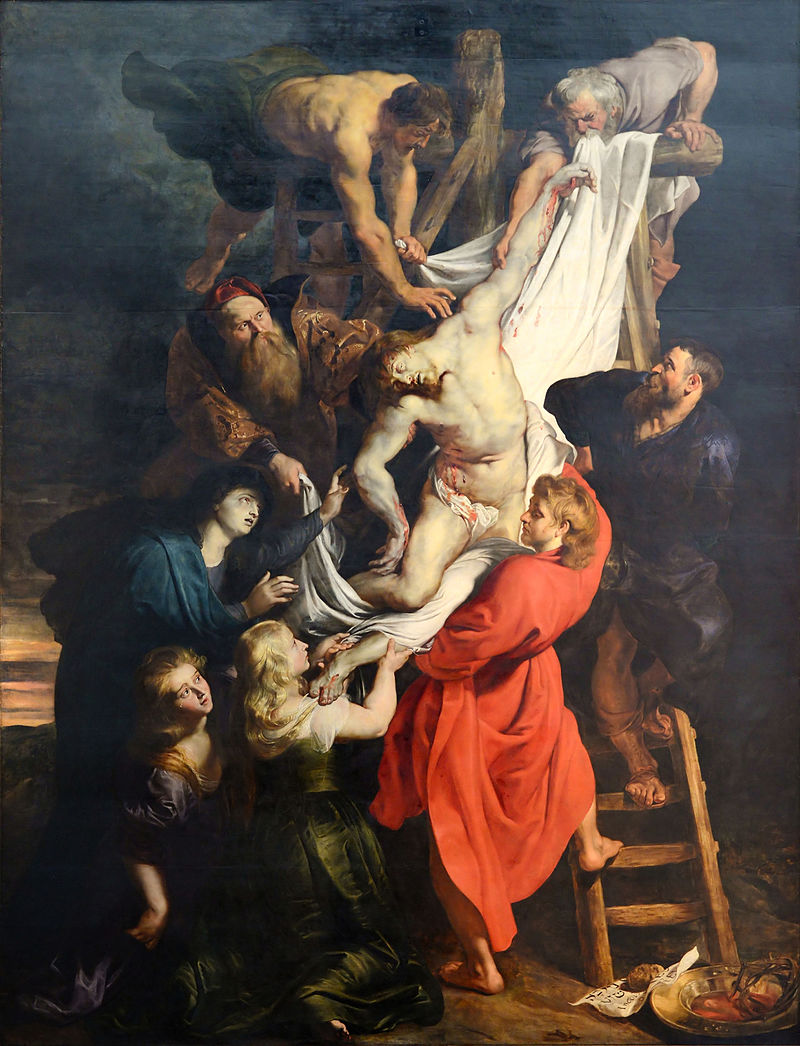
Even if this sounds somewhat vainglorious, when you examine the mastery of his most ambitious works such as The Descent from the Cross, it is difficult to disagree with him.
Rubens (1577-1640) was a remarkable man with many feathers to his cap – he ran a successful studio in Antwerp, was a classically educated humanist scholar and diplomat, who was knighted by not one but two kings, and received an honorary Master of Arts degree from Cambridge University.
At fourteen, Rubens turned to painting, having tired of his first career as a court page to a countess, and began his artistic studies.
He soon set out to travel around Italy, making endless copies of the seminal Renaissance and classical works he had heard much about.
Despite his change in career, the royal courts and the nobility remained a fascination for Rubens.
He returned to Antwerp from his studies, and his skills were soon noted, enabling him to secure a position as a court painter to the heads of state.
Rubens built a studio large enough to house his students and assistants – his steadily growing commissions required many able hands to help complete some of his output.
Soon he found himself running a thriving business, and enjoyed working on a large and dramatic scale, creating grand altarpieces.
The early part of the 1600s was a time of turbulent relations between the Dutch and the Spanish, due in part to religious differences.
Rubens’ work was seen as playing a part in promoting the
Catholic cause, in a baroque propaganda campaign.
The Descent from the Cross shows the body of Christ being tenderly removed from the cross after his crucifixion, a subject he returned to repeatedly.
Devout portrayals were of paramount interest to Rubens, who explained: ‘my passion comes from the heavens, not from earthly musings.’
As a prominent altarpiece, the work clearly needed to be impressive, and also echo the role of the guild of the Cathedral of our Lady in Antwerp, whose patron saint was St. Christopher – the Christ Bearer.
Throughout the central panel as well as the accompanying parts of the triptych, the theme of carrying and being carried is referred to repeatedly.
In the first panel a pregnant Mary is depicted visiting her cousin, while the third panel shows the baby Jesus being carried into the temple.
Rubens flexes his artistic muscles in this work, intending to demonstrate what he was capable of, to powerfully establish his pre-eminence.
Eight figures carry the ashen white, blooded body of Jesus down from the cross – two men at the top of ladders lowering Christ, one of whom rests on the figure of Magdalene for support. The Virgin extends her arms towards her son, while St. John supports him on his descent.
Rubens rooted the work in Venetian traditions, creating a dark and unsettling mood, clarifying that something devastating has happened, all the while portraying the event colourfully, even flamboyantly.
The pallor of Christ’s body contrasts sharply with the dark background, and the figures are lit in bright colours, carrying the body of Christ in such a way as to make him appear almost weightless.
In order to create this remarkable tour de force, as he did with all his other work, Rubens painted with great discipline. He rose at 4am every morning and would carry on working until 5pm, toiling harder than any of his assistants.
Observers noted that while he painted he enjoyed having a work of classical literature read to him. Rubens seemed to believe that this helped him create works and convey characters with eloquent grace.
The great altarpiece of Christ’s descent further established
Rubens’ credentials, and he soon threw himself into his diplomatic responsibilities, spending several months in England.
Here he took on further commissions, including the ceiling of the banqueting house at Whitehall.
As painters routinely travelled to foreign courts, Rubens was well placed to execute his diplomatic duties delicately, without arousing attention regarding his political role.
He was a sociable character and a collector of gems, art, ancient sculpture and coins, as well as varied curiosities, including an Egyptian mummy.
This eclectic hoard was also useful in his work as a diplomat, as it attracted visiting dignitaries.
Rubens was also something of an entrepreneur, and used the production of prints and book title pages as promotions to extend his fame throughout Europe.
Although some critics sniffily pointed out that he often merely fully painted the faces and hands of his subjects, and simply supervised his students to carry out much of the work, this has now been largely discounted.
For his most important pictures Rubens was painstaking in every detail, and it was only his brush that was allowed to touch the painting.
This was particularly the case with the curvaceous female forms that he loved to paint, the Rubensesque women, as breath-taking today as they were on the day they were completed.
The female nude took on a fresh perspective in the art of Rubens, who clearly delighted in women of ample proportions.
He made fleshy corpulence appear alluring and radiant – his classical studies of mythological heroines portrayed in utmost splendour.
The abundance of subjects in his more striking pictures helped produce a three-dimensional effect, with the protagonists in each painting creating the focus point.
Rich in content and symbolism, his works contained a natural flow and a beguiling narrative.
Today he is recognised as single-handedly transforming the Baroque into an international art form, building upon the early Renaissance works he studied so carefully as a young man touring Italy. Never before had an artist produced such a diverse range of subjects, and to some Rubens’ genius surpassed even that of Titian, his greatest inspiration.