
The Liver is the Cock’s Comb
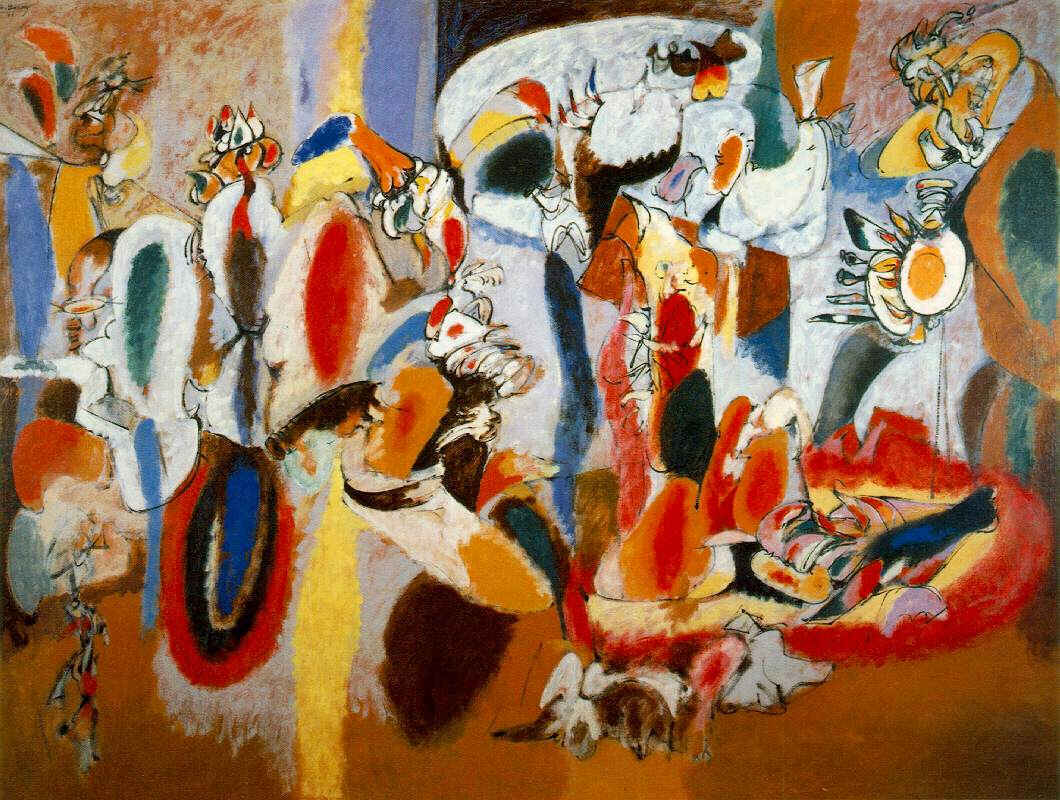
He arrived in America in 1920 as a sixteen-year-old immigrant, a refugee from the Turkish assault on the Armenian population.
It had been a harrowing journey, often subjected to exposure and lack of food, his mother dying of starvation in his arms.
The boy reinvented himself completely once in the U.S, quickly learning English and adopting the name Arshile Gorky, determined to bury his pauper adolescence.
He claimed he was a Georgian noble, and the nephew of Maxim Gorky, the famous Russian writer. Other inventions he passed among his new acquaintances of youthful painters were that he had studied with Kandinsky in Paris, and graduated from Brown University.
He even emulated, to the point of copying, the works of many other artists – Cézanne, Picasso, Léger, Miró – teaching himself how to paint, before eventually finding his own emphatic voice.
New York was a great source of inspiration for Gorky, who for example, felt that fire hydrants were like cathedrals, and being machine-made they were more beautiful than anything that mere man could achieve.
Gorky managed to talk his way into getting an exhibition of his new abstract works at dealer Julien Levy’s gallery. Art critics were stony and unresponsive, and the opening was a dismal affair, Levy having failed to send out invitations; it was a cosy party of six.
Gorky was never to achieve the recognition he deserved until far later, but even then, not by the art world in general.
Even after his death critics remained as dismissive as ever about his work.
The December 1948 edition of Artnews, the world’s premier art magazine, was published five months after Gorky’s death, but chose to include not a posthumous tribute but a derisively brief dismissal of his final show.
But to some vocal admirers he had been recognised as one of the most powerful painters of the 20th century – the last
Surrealist and first Abstract Expressionist.
When the influential André Breton, the most important voice of the Surrealist movement and author of the Surrealist Manifesto, saw The Liver Is the Cock’s Comb, the largest painting Gorky had completed, he was startled and awestruck.
Breton declared it ‘one of the most important paintings made in America’. He greatly admired its combination of nature and reality, filtered through memory and feeling.
The picture certainly prefigured Abstract Expressionism and lit the way for the coming generations of American artists. But among the insinuations put about by important figures in the art world was the claim that Gorky was an acolyte of the more successful Willem de Kooning. De Kooning immediately protested that the opposite was true.
His letter remains the best of epitaphs: ‘When, about 15 years ago, I walked into Arshile’s studio for the first time the atmosphere was so beautiful I got a little dizzy, and when I came to, I was bright enough to take the hint immediately.’
Though abstracted to a great degree, this work nevertheless reveals Gorky’s fondness for organic forms loosely based in nature, and his use of sumptuous colours that were proving essential in his mature style.
The influence of Kandinsky is seen in the flowing details, pointed shapes, the charged field of ‘oriental’ colours scattered against greys, and the feathery brushstrokes.
But the source of his remarkable new approach to paint remains enigmatic. The scholar Harry Rand has discussed the content of this picture at length, pointing out the rooster-headed figure with the feathered groin at the right is portrayed as the vain fool.
Rand explains that the liver was once thought of as the seat of passion, punning on the ‘cock’s comb’ part of the title, and suggesting that ‘Love is the vanity of the penis’ or, more simply, ‘love is lust’.
Others found autobiography in the art – ploughs and palettes, his father’s orchard, his mother’s apron – but whatever the paintings absorb from his anguished life, they also transcend.
And poor Arshile certainly experienced more than his share of anguish. Even his childlike dream that the important art critics would one day turn around and clasp him by the hand and say, ‘Gorky we love you, we love your work,’ was never to be fulfilled.
In 1946 Gorky’s studio burnt to the ground, and everything was destroyed.He was painting intently and smelt smoke, but thought it was his cigarette and carried on working.
Despite losing everything Gorky didn’t allow himself to appear too perturbed about it.
But this was the first disaster of many that would cause him to isolate himself from his friends and family.
That same year he needed surgery for rectal cancer and learnt that he would have to forever wear a colostomy bag.
He found this indignity debilitating, and starved himself so that his bag’s gurgles and other embarrassing splutters would be kept to a minimum.
Later in the year Gorky was involved in a car crash when driving with his dealer Julien Levy; both were drunk and sustained injuries, but Gorky came off far worse – his painting arm was paralysed.
For Gorky his art had been therapy, keeping his life manageable – thinking about his paintings, working them through, drawing on his memories.
He felt he couldn’t continue living without being able to paint.
His beloved wife Mougouch, now witnessing his great frustration and bitterness, became increasingly concerned.
When her husband left to walk into the woods, thinking that his wife wouldn’t notice he would carry a long rope over his shoulder, planning on taking his own life.
She watched him closely, and each time Mougouch sent their two little girls Maro and Natasha running after him saying, ‘Quick girls, follow Daddy, he’s going to build you a swing!’
As they caught up to their father, excitable and adoring,
Gorky wouldn’t be able to go through with his plan and would return up to the house with his daughters.
Finally, Gorky called Mougouch and told her, ‘I’m going to free you.’ On July 21 1948 Gorky left a painting on the easel, ‘Goodbye my lover.’ Poor Gorky even borrowed his last words from the great Russian writer Pushkin, in order to leave the best impression.
He walked into the forest to hang himself, and this time Mougouch wasn’t there to stop him.