
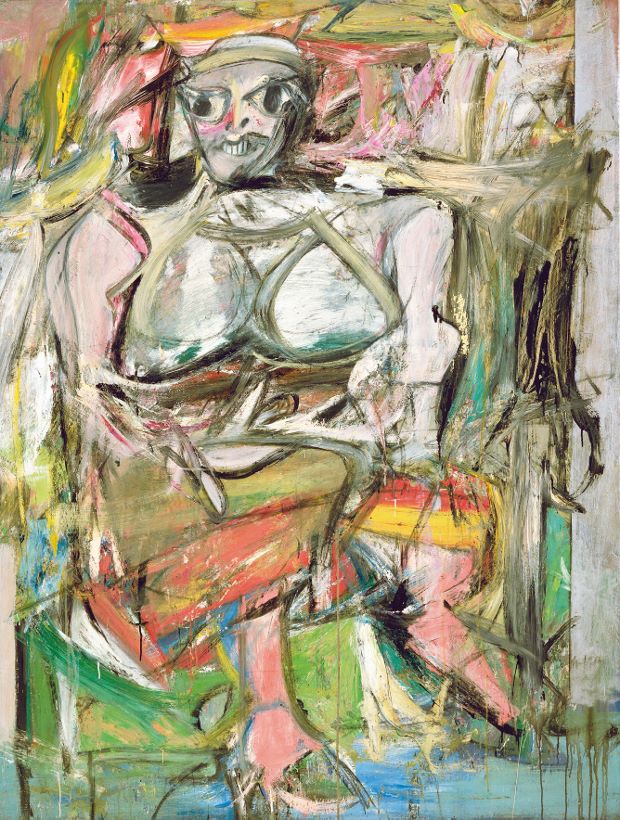
Woman 1
Willem de Kooning arrived in New York in 1926 with no papers and unable to speak a word of English.
He had studied in night classes at the Rotterdam Academy of Fine Arts and Techniques and was able to find work as a commercial art designer, and in creating window displays.
De Kooning (1904-1956) would paint whenever he could, and soon found friends in the local artistic community.
He was fortunate to gain a position in the mural division of the Work Project Administration, and his network of artist colleagues gradually expanded.
One auspicious day, de Kooning and his close friend, the brilliant Franz Kline went to look for inexpensive black and white household enamel, unable to afford traditional pigment paint.
This money-saving purchase led to de Kooning’s first individual exhibition in 1948, consisting entirely of paintings using these two colours.
Few of the works sold, but they were well received by other artists and some critics.
But wonderfully for de Kooning, the Art Institute of Chicago awarded him a purchase prize for one of the works from this period – Excavation, now considered to be one of de Kooning’s greatest paintings, and an important highlight of the museum’s collection.
Soon he gained invaluable support from two art critics who both held great sway in the art world: Clement Greenberg and Harold Rosenberg.
He was included in MoMA’s exhibition ‘New Horizons in American Art’, but his paintings of male portraits were a struggle for de Kooning – he could not resolve specific areas such as hands, shoulders and hair – and his nervous reworking of these parts of the pictures made many of them appear incomplete.
This ‘unfinished’ appearance was to become his signature approach.
When he started work on his Women series of paintings, they took him to a new direction; they were no longer the ladylike forms he had once pursued.
He worked on Woman1 for two years, occasionally discarding the work in frustration. Fortunately the art historian Meyer Schapiro was encouraging about the picture when he visited de Kooning’s studio.
De Kooning was delighted and told his dealer, ‘He’s one of those who tells you that you should be doing what you’re doing, not one of those who tell you not to do what you’re doing. Tell him to come again!’
De Kooning’s six Women paintings erupted on the New York art world at the highly influential Sidney Janis Gallery in 1953 – and Woman1 was acquired by MoMA.
The purchase was a controversial one, as the picture unsettled many trustees of the museum who found the staring image ferocious, even disturbing – they only gave grudging approval to the acquisition due to the painting’s intense energy and striking use of colour.
De Kooning was accused of misogyny due to his unappealing portrayal of each of his women – objectified, threatening, maniacally grinning, and just plain scary.
He had often relied on found photography for inspiration, incorporating collage into a number of preliminary studies in the early stages of Woman1, which he later removed.
De Kooning would fill his canvases with image after image, only to scrape away the figure and repeatedly paint over; approximately two hundred pictures and studies were used to create the final version of Woman1.
The composition varies in hues from pink, yellow, white, grey, orange, blue and green.
De Kooning liked working in oils, explaining, ‘Flesh is the reason oil paint was invented.’
The figures in the paintings are delineated with thick black contouring lines that distinguish the female body from the aggressive brushstrokes surrounding her.
The lipless woman has broad shoulders and large breasts, with bulging eyes that take up half her face.
The portraits leave his women flattened, and looking uncomfortable.
Nevertheless, de Kooning’s popularity grew rapidly, and he was seen as a central figure in the exciting new movement Greenberg and Rosenberg were championing: Abstract Expressionism.
He enjoyed socialising with his fellow artists, and was a loyal fixture at the Cedar Tavern on Tenth Street, unofficial home of New York’s most avant-garde artists.
He remained close to Franz Kline, but was perhaps wary of Jackson Pollock – like other artists he was in some awe of Pollock’s overwhelming talent, and the passionate viewpoints he articulated in the endless debates about art and theory.
In 1961 de Kooning became an American citizen, after having lived in the U.S.A. for thirty-five years. He settled in a farmhouse with a large studio in East Hampton, in the countryside outside New York, where both the light and the landscape reminded de Kooning of his native Holland. This soon became apparent in his work.
His figurative paintings were no longer fierce, but softened and loosely painted.
He began to experiment with sculpture, working in clay to be cast in bronze, and these works too were soon to be widely admired.
His home life was anything but stable. He had married his apprentice Elaine, and despite many separations and feuds their marriage withstood forty-five years.
Of course, commentators noted that his notorious Women series began after his marriage to Elaine. But despite his multiple affairs, their chaotic relationship, his drunken rages, his frequent betrayals – they somehow remained united until her death in 1989.
De Kooning’s later works of lyrical abstraction were completed during his final years when he was diagnosed with Alzheimer’s disease.
Initially treated with scepticism, these works grew in stature and are now considered luminously majestic. He completed the last of them six years before his death in 1997.
But perhaps nothing explains de Kooning and his thinking better than his uncompromising viewpoint: ‘Beauty becomes petulant to me. I like grotesque. It’s more joyous.’ And de Kooning would be proud that his art college, the Rotterdam Academy of Fine Art and Techniques, changed its name: in 1998 it became the Willem de Kooning Academie.